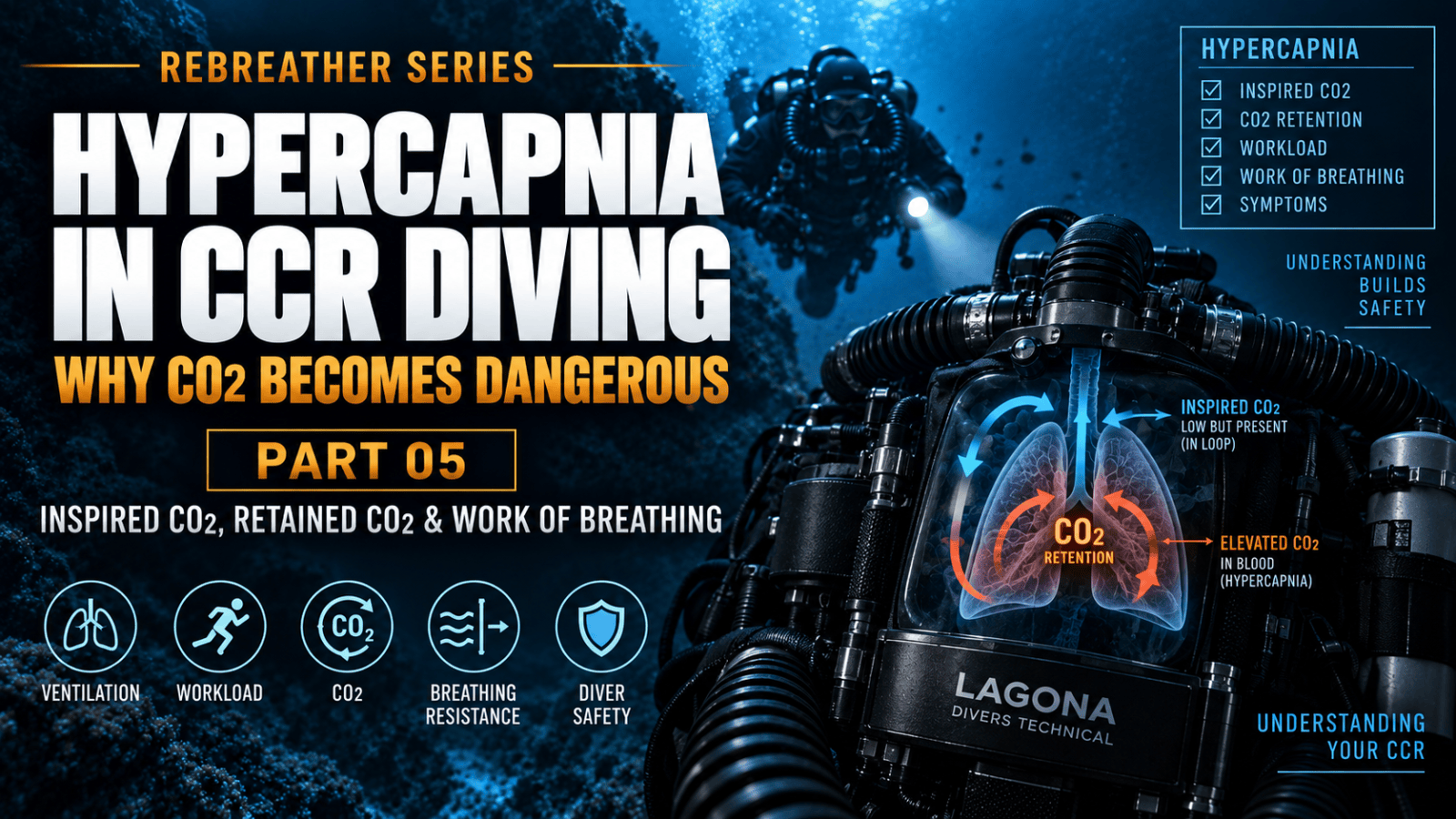
Hypercapnia in CCR Diving: CO₂ Retention Explained
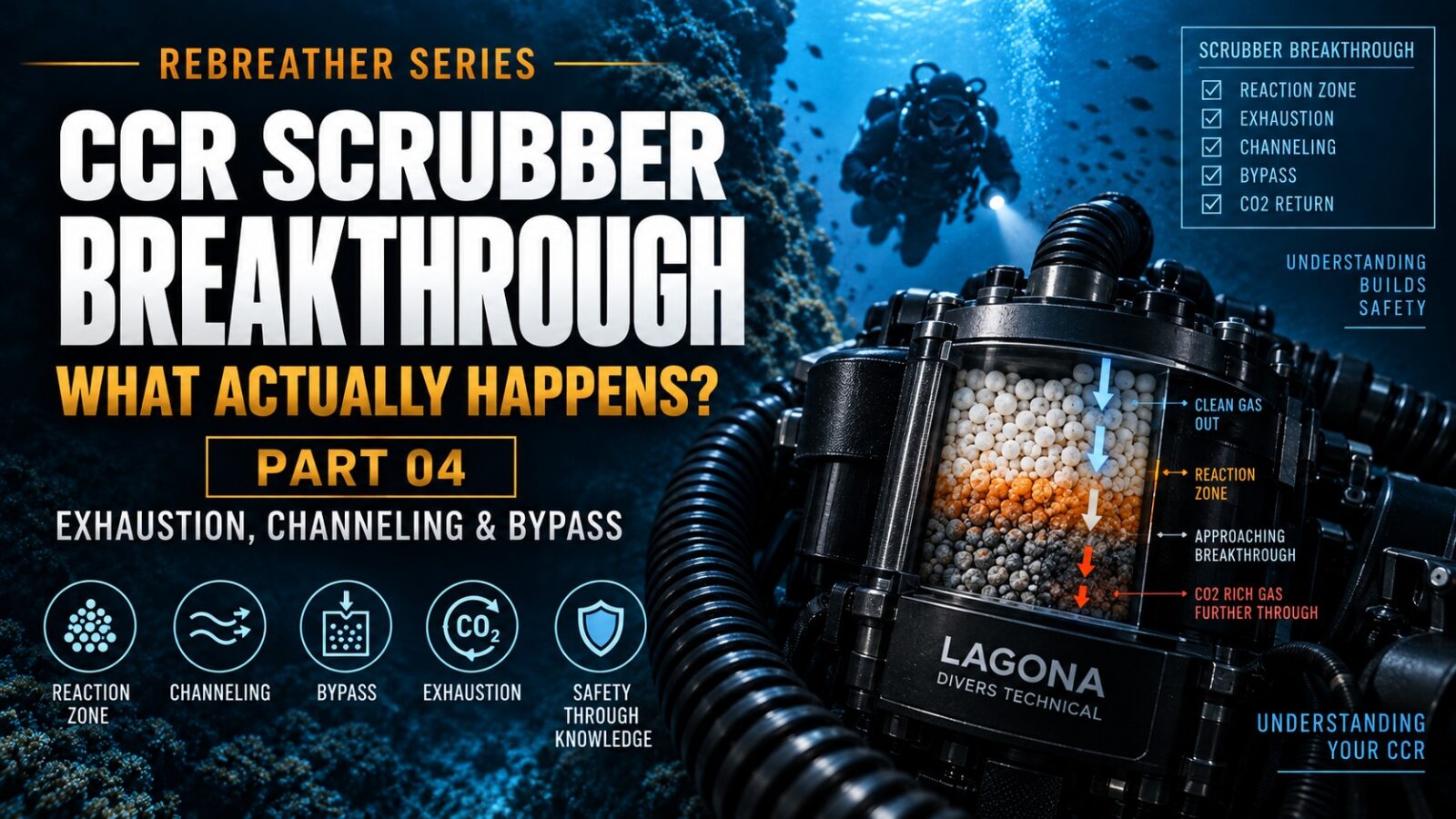
In Part 04, we followed carbon dioxide through the rebreather scrubber. We looked at what happens when CO₂ is no longer removed adequately and can return toward the diver in the breathing loop.
Now we follow the problem into the diver.
Scrubber breakthrough and hypercapnia are not the same thing. Scrubber breakthrough describes inadequate CO₂ removal in the rebreather. Hypercapnia describes an abnormally elevated level of CO₂ in the diver.
The distinction becomes particularly important because a scrubber problem is not the only way a CCR diver can become hypercapnic. CO₂ can be present in the gas the diver inhales, but CO₂ can also accumulate because the diver is not eliminating metabolically produced CO₂ adequately. A functioning scrubber therefore does not make hypercapnia impossible.
The better technical question is:
How can CO₂ accumulate in a CCR diver, even when the rebreather appears to be functioning correctly?
Understanding that requires us to look beyond the scrubber and at the interaction between metabolism, ventilation, breathing resistance, gas density, workload and the diver’s individual physiological response.
Hypercapnia in CCR Diving at a Glance
| Factor | What is happening |
|---|---|
| Hypercapnia | CO₂ in the diver becomes abnormally elevated |
| Inspired CO₂ | CO₂ is present in gas the diver inhales |
| Retained CO₂ | Metabolically produced CO₂ is not eliminated adequately |
| Workload | Metabolic CO₂ production increases |
| Breathing resistance | Maintaining the ventilation required to eliminate CO₂ can become more demanding |
| Gas density | Denser gas increases respiratory loading and can make high ventilation more difficult |
| Recognition | Symptoms vary and can overlap with ordinary underwater exertion or other problems |
| CCR monitoring | Loop CO₂ measurement is not the same as measuring CO₂ retained inside the diver |
The important point is that hypercapnia in CCR diving is not purely an equipment problem. The rebreather and the diver are both part of the CO₂-management system.
What Is Hypercapnia?
Your body continuously produces carbon dioxide as a product of metabolism. That CO₂ is transported in the blood to the lungs, transferred into the gas inside the lungs and then removed through exhalation.
Under normal conditions, CO₂ production and CO₂ elimination remain in balance. When metabolic activity increases, such as during exercise, CO₂ production rises and ventilation normally increases to remove the additional CO₂.
Hypercapnia develops when CO₂ accumulates because elimination is not keeping pace with the amount entering or being produced in the body. In diving, that can occur through more than one mechanism.
A major review of hypercapnia in diving describes both elevated inspired CO₂, such as can occur when a rebreather’s CO₂-removal system becomes ineffective, and increases in arterial CO₂ occurring without an increase in inspired CO₂ because alveolar ventilation has become inadequate.
That gives us the first critical distinction.
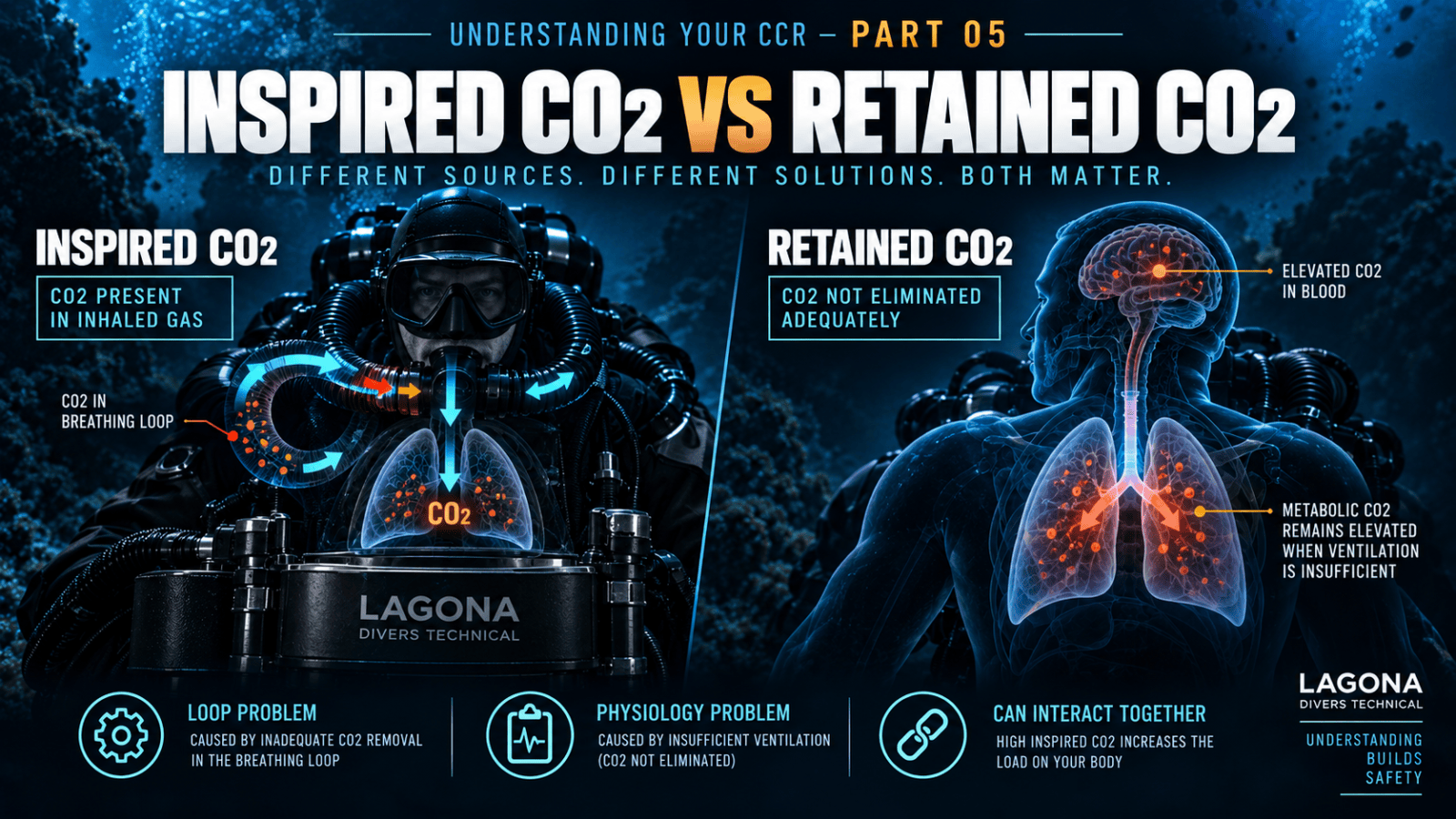
Inspired CO₂ vs Retained CO₂
Inspired CO₂ and retained CO₂ can both contribute to hypercapnia, but they are not the same problem.
What Is Inspired CO₂?
Inspired CO₂ means carbon dioxide is already present in the gas reaching the diver during inhalation.
On a correctly functioning CCR, metabolically produced CO₂ is exhaled into the loop and should then be removed by the scrubber before the breathing gas returns to the diver. Part 04 examined what happens when that removal becomes inadequate.
If CO₂ passes through or around the intended CO₂-removal system and returns toward the diver, the diver may begin inhaling CO₂ that should have been removed.
That is the equipment-side pathway into the physiological problem.
What Is Retained CO₂?
Retained CO₂ is different. The breathing gas reaching the diver may contain very little CO₂, while CO₂ still accumulates inside the body because ventilation is insufficient to eliminate the CO₂ being produced by metabolism.
This is sometimes described in diving discussions as CO₂ retention.
It should not be reduced to the idea that somebody simply “wasn’t breathing enough.” Underwater CO₂ retention can involve the interaction of workload, breathing resistance, gas density, respiratory control, effective alveolar ventilation and individual physiological response. Diving itself changes respiratory conditions in ways that can make CO₂ elimination more difficult.
Can Inspired CO₂ and Retained CO₂ Occur Together?
Yes.
A diver may already be producing a large amount of CO₂ because of increased workload while also facing substantial respiratory loading. If inspired CO₂ is then added because the rebreather is not removing CO₂ adequately, the two mechanisms can interact.
That is one reason thinking only in terms of “scrubber failure” gives an incomplete model of hypercapnia.
Can a CCR Diver Become Hypercapnic With a Working Scrubber?
Yes.
This is probably the most important distinction in the entire article.
A scrubber removes CO₂ from breathing gas passing through the loop. It does not control the ventilation taking place inside the diver’s lungs.
If the diver’s metabolic CO₂ production rises and effective ventilation does not increase sufficiently to eliminate it, arterial CO₂ can rise even though inspired CO₂ remains low and the scrubber is functioning correctly. Diving research specifically describes this mechanism of hypercapnia occurring without an increase in inspired CO₂.
A functioning scrubber therefore solves one part of the CO₂ problem:
It removes CO₂ from the breathing loop.
The diver still has to solve the other:
The respiratory system must move CO₂ from the body into the exhaled gas.
If either side of that chain becomes ineffective, CO₂ can become a problem.
Why CCR Diving Can Make CO₂ Elimination More Difficult
Breathing underwater is not physiologically identical to breathing on the surface. Immersion, increased gas density, respiratory loading and the breathing apparatus itself can all affect respiratory mechanics.
On CCR, the diver is also moving breathing gas through an entire breathing circuit. The exact work of breathing depends on the rebreather, its configuration, breathing position, gas, depth and ventilation rate.
None of these factors alone means that hypercapnia will occur. The concern is how they interact when metabolic demand and respiratory demand rise at the same time.
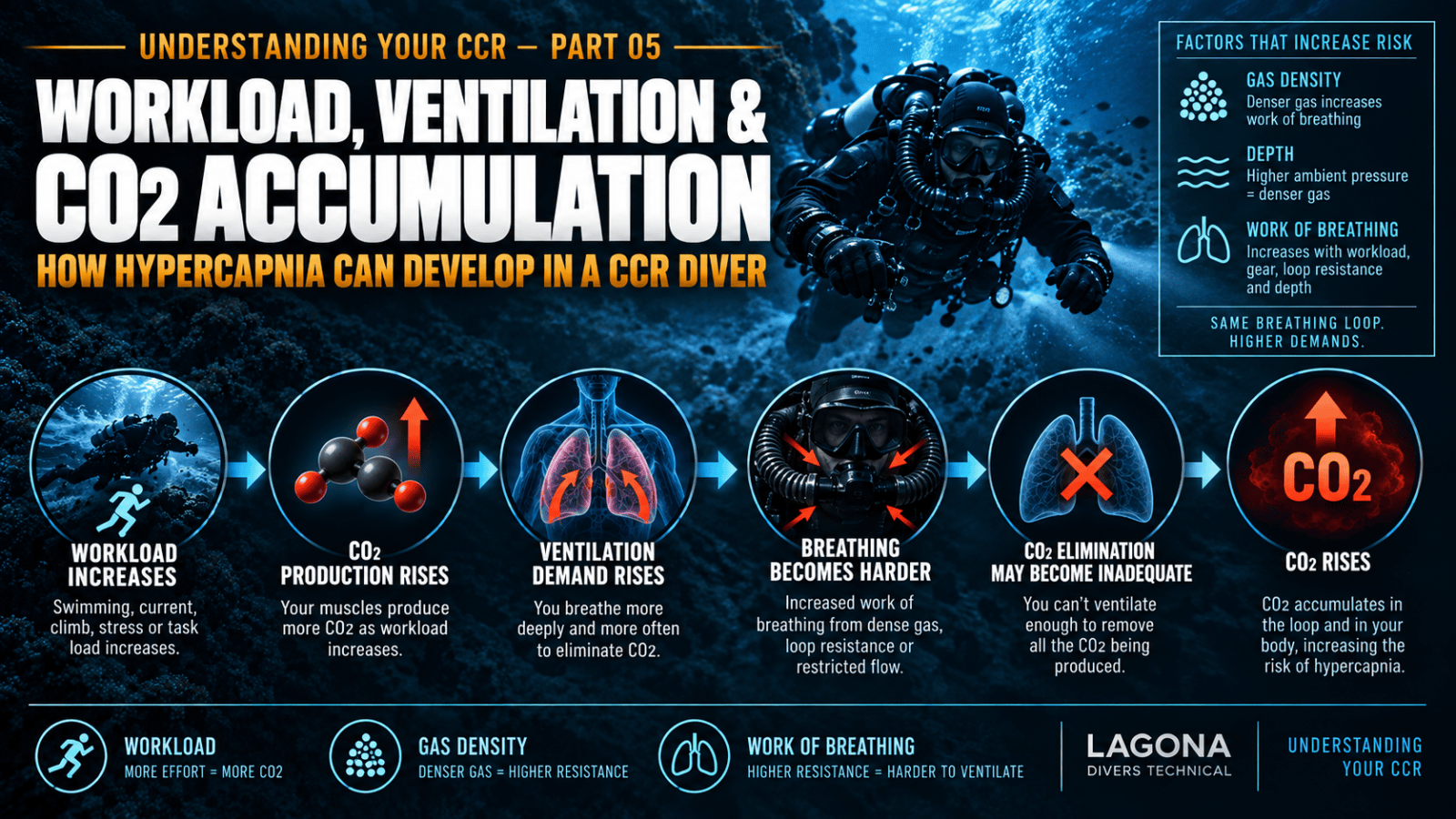
Workload Increases CO₂ Production
Two divers can be on the same CCR, at the same depth, breathing the same gas and still have very different CO₂ production.
A diver hovering calmly is metabolically different from a diver swimming hard into current, moving equipment, dealing with a problem or trying to maintain position while task-loaded. As muscular work increases, metabolism rises and more CO₂ is produced.
That additional CO₂ has to be eliminated.
Normally the body responds to increased metabolic demand by increasing ventilation. Underwater, however, increasing ventilation can require substantially more respiratory effort than it would at the surface.
The result is an important relationship:
As workload increases, the diver produces more CO₂ at exactly the time that greater ventilation is required to eliminate it.
Ventilation Is More Than Simply Breathing Faster
Minute ventilation describes the total amount of gas moved into and out of the respiratory system over time. But not every part of every breath participates equally in gas exchange.
Some ventilation occupies anatomical and physiological dead space rather than reaching gas-exchange regions of the lungs. What matters for CO₂ elimination is therefore effective alveolar ventilation, not simply how visibly fast or deeply somebody appears to be breathing.
Diving conditions can influence both ventilation and physiological dead space. Elevated breathing-gas density and respiratory loading are among the mechanisms discussed in diving research as contributors to CO₂ retention underwater.
This is why the explanation “the diver should just breathe more” is technically inadequate.
Gas Density, Depth and Work of Breathing
As ambient pressure increases, the density of the breathing gas increases unless the gas composition is changed appropriately. Moving denser gas requires greater respiratory effort, particularly at the higher flow rates required during exercise.
Research into pulmonary gas exchange under diving conditions describes increased respiratory loading and density-related effects as important contributors to reduced effective ventilation and hypercapnia.
This becomes particularly relevant when workload rises. A diver who needs significantly greater ventilation may find that moving the required volume of dense gas through both the respiratory system and breathing apparatus becomes increasingly demanding.
Experimental work examining exercise while breathing through resistance has demonstrated that breathing resistance can reduce ventilation and, when combined with inspired CO₂, produce greater CO₂ retention. Subjects in that study also identified hypercapnia poorly.
This is why breathing-gas choice at depth is not only a narcosis question. Gas density is also a respiratory-performance question.
The purpose here is not to establish universal gas-density limits or prescribe a particular diluent. Those decisions belong within appropriate technical-diving planning, training and the limits applicable to the dive. The important physiological principle is that gas density affects how difficult it is to move the ventilation the diver requires.
Rebreather Work of Breathing and Hydrostatic Effects
A CCR adds its own breathing-system characteristics to the diver’s respiratory workload. Gas has to move through components such as the mouthpiece or BOV, breathing hoses, one-way valves, counterlungs and scrubber.
The pressure relationship between the counterlungs and the diver’s lungs also changes with equipment design and body position. This is commonly discussed in terms of hydrostatic imbalance or static lung load.
The practical point is not that one counterlung position is universally correct for every rebreather. Different designs behave differently. The important point is that the relative position of the breathing-gas reservoir and the diver’s lungs can influence the pressure required during inhalation and exhalation. Diving physiology literature confirms that posture and breathing-apparatus configuration can alter this hydrostatic relationship and respiratory loading.
For a CCR diver, trim and equipment configuration therefore have functional consequences beyond appearance. How the unit breathes in the diver’s actual position matters.
Why Some Divers Retain More CO₂ Than Others
Not every diver responds to respiratory loading in exactly the same way.
Some individuals increase ventilation strongly when CO₂ rises, while others may show a comparatively lower ventilatory response. Diving literature has long discussed individual variation in susceptibility to CO₂ retention, sometimes referring informally to individuals who tend toward higher CO₂ levels as “CO₂ retainers.”
That does not mean divers should diagnose themselves into simple categories. The useful lesson is that identical equipment, depth and workload do not guarantee identical physiological responses.
One diver appearing comfortable under a particular respiratory load does not prove that another diver will respond the same way.
What Does Hypercapnia Feel Like?
Hypercapnia can affect both respiratory comfort and neurological function. Possible manifestations include a strong urge to breathe, shortness of breath or difficult breathing, light-headedness, headache, feelings of warmth or flushing, impaired concentration, confusion or disorientation, anxiety or distress, declining physical performance and, when sufficiently severe, loss of consciousness.
But the list is less important than the limitation behind it:
Symptoms are not a dependable CO₂ monitor.
A 2026 randomized controlled study examining hypercapnia recognition in divers found that shortness of breath, light-headedness and disorientation were among the most intensely reported symptoms. Importantly, symptom responses were not highly consistent between repeated exposures: only about half of the divers who experienced hypercapnia on two occasions showed a correlated symptom response between the sessions.
A diver should therefore not expect a perfectly repeatable sequence in which a mild headache always appears first and progressively obvious symptoms provide plenty of warning.
Why Hypercapnia Can Be Difficult to Recognize Underwater
Many symptoms associated with rising CO₂ can resemble ordinary experiences during a demanding dive.
Breathing may feel harder because the diver is working. The diver may already feel warm because of exertion. Attention may already be divided between navigation, buoyancy, decompression obligations, team awareness and equipment management.
At the same time, rising CO₂ can impair cognition and judgement.
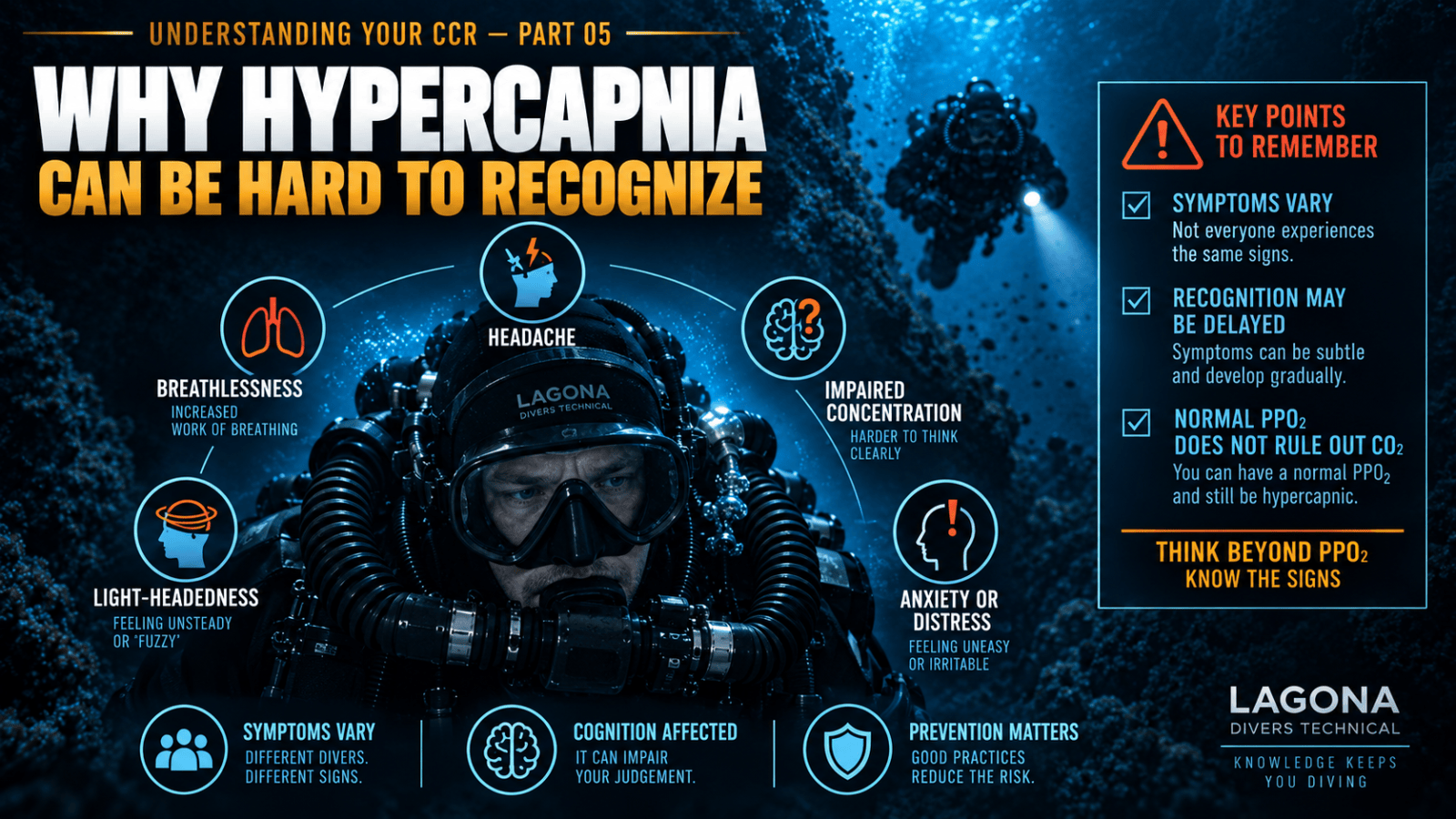
That creates a particularly difficult recognition problem: the physiological disturbance can affect the same diver who needs to identify and respond to it.
The 2026 diver-recognition study highlighted this problem directly. It also noted that inspired-CO₂ monitoring cannot detect hypercapnia caused by disturbed respiratory control when inspired CO₂ itself remains low.
This is why CO₂ management cannot sensibly be built around the assumption:
“I’ll know when my CO₂ gets high.”
Recognition may come late, symptoms may overlap with exertion, and different episodes may not feel identical.
The CO₂ Feedback Loop
Once significant respiratory difficulty develops, several factors can begin reinforcing each other.
A useful conceptual model is:
Workload increases → metabolic CO₂ production increases → ventilation demand increases → breathing becomes more demanding → CO₂ elimination becomes inadequate → CO₂ rises → breathlessness and cognitive stress increase → physical effort may increase further.
This is not a claim that every hypercapnic event follows an identical sequence. It is a way of understanding why a CO₂ problem can become increasingly difficult to manage once respiratory demand approaches what the diver can effectively sustain.
A published analysis of a fatal extreme-depth technical rebreather dive described a similar physiological spiral involving dense gas, limited ventilatory capacity, increasing CO₂ and wasted respiratory effort. The case involved extreme conditions and should not be generalized directly to ordinary CCR diving, but it demonstrates that respiratory performance has real physiological limits.
Why CO₂ and Panic Can Become a Dangerous Combination
Carbon dioxide is a powerful driver of ventilation. Rising CO₂ can create an intense sensation of needing to breathe, and severe breathlessness underwater can be psychologically difficult to separate from a problem with the breathing apparatus itself.
If distress leads to harder swimming, rapid movements or unnecessary physical effort, metabolic CO₂ production can rise further. Cognitive impairment can simultaneously make disciplined problem solving more difficult.
This does not mean that hypercapnia inevitably causes panic. Nor should every distressed diver be assumed to be hypercapnic.
The relevant point is that respiratory distress, increased workload and impaired decision-making can interact in an environment where the diver’s ability to breathe and think clearly is critical.
That is one reason good CCR training emphasizes controlled responses, workload awareness and understanding the breathing system rather than simply memorizing displays and procedures.
Why Hypercapnia Matters Beyond CO₂
CO₂ does not act in isolation from the other physiological stresses of technical and rebreather diving.
Of particular importance is its relationship with oxygen.
Hypercapnia and CNS Oxygen Toxicity
Elevated CO₂ is considered an important factor in susceptibility to central nervous system oxygen toxicity. Hypercapnia can increase cerebral blood flow and consequently increase oxygen delivery to the brain, which is one reason elevated CO₂ and elevated oxygen exposure are an undesirable combination. The relationship is recognized in both diving research and recent hypercapnia literature.
That statement needs to be interpreted carefully.
Hypercapnia does not mean an oxygen-toxicity seizure will automatically occur.
It means that CO₂ is an additional physiological factor that deserves particular respect when the diver is also exposed to elevated PPO₂.
This is another reason a normal oxygen reading alone cannot tell you that the diver’s complete respiratory situation is normal.
Can You See Hypercapnia on Your CCR Handset?
Usually, the most prominent life-support information presented by a CCR relates to oxygen partial pressure.
That creates an important conceptual trap:
Normal-looking PPO₂ does not prove that CO₂ is normal.
Oxygen and carbon dioxide are different variables. A CCR can maintain the intended PPO₂ while the diver is retaining CO₂ physiologically. Likewise, maintaining PPO₂ does not compensate for inspired CO₂ caused by inadequate CO₂ removal.
Some rebreathers provide additional CO₂-related information, but the distinction between loop CO₂ and diver CO₂ must remain clear.
What Can an Inspired-CO₂ Sensor Tell You?
A CO₂ sensor located in the breathing circuit can provide information about CO₂ in the gas being monitored.
That can potentially provide information relevant to inspired CO₂ or scrubber performance, depending on the system and sensor location.
What it cannot do is directly measure the arterial CO₂ inside the diver.
Recent diving research makes this distinction explicitly: inspired-CO₂ monitors can identify CO₂ in the breathing gas, but they cannot detect hypercapnia caused by inadequate physiological ventilation when inspired CO₂ remains low.
What About the CO₂ Sensor on the XCCR?
The XCCR, which we teach at Lagona Divers Technical, incorporates a solid-state CO₂ sensor alongside three oxygen sensors in its removable sensor cartridge. Manufacturer documentation also specifies CO₂ readout through the primary controller. XCCR Rebreather
That makes the XCCR useful for illustrating the distinction between what the machine can monitor and what is happening physiologically.
The sensor provides information about CO₂ in the breathing gas. It does not directly measure the CO₂ level in the diver’s blood.
A diver can therefore retain CO₂ while the scrubber is operating correctly and loop CO₂ remains low. Understanding what a sensor can tell you is useful; understanding what it cannot tell you is equally important.
What About Skip Breathing?
Intentionally suppressing ventilation is sometimes discussed in open-circuit diving as a way of reducing gas consumption. Whatever the motivation, reducing effective ventilation can interfere with CO₂ elimination.
On CCR, deliberately restricting normal breathing makes even less operational sense as a gas-conservation strategy because the rebreather already achieves its efficiency by recycling breathing gas while replacing metabolically consumed oxygen.
The physiological requirement remains unchanged: the body must eliminate the CO₂ it produces.
A diver should not treat reduced ventilation as an efficiency technique.
CO₂ Management Starts Before There Is a CO₂ Problem
Understanding hypercapnia should not encourage a diver to wait for symptoms and then attempt to diagnose the precise physiology underwater.
The stronger approach is to understand the factors that can move the diver toward a CO₂ problem in the first place.
For a CCR diver, that means appreciating the importance of correct unit preparation and scrubber procedures, appropriate breathing-gas planning, rebreather work of breathing, equipment configuration, workload, depth, respiratory effort and normal effective ventilation.
It also means understanding that procedures and operating limits established for the specific CCR are there for a reason. Knowledge of the underlying physiology should make those limits more meaningful, not encourage personal experiments beyond them.
This article explains the mechanisms. Unit-specific responses and emergency procedures belong to proper CCR training and to the procedures applicable to the rebreather being used.
The Scrubber Is Only Half of the CO₂ System
The diver’s lungs must first remove CO₂ from the body and transfer it into exhaled gas. The CCR scrubber must then remove that CO₂ from the breathing loop before the gas returns to the diver.
Think of the chain this way:
Metabolism produces CO₂ → the blood transports it → the lungs transfer it into exhaled gas → the CCR scrubber removes it from the loop.
Hypercapnia can develop if CO₂ returns in the inspired gas, if the diver cannot eliminate metabolic CO₂ effectively, or if both mechanisms occur together.
That is the more complete CCR mental model.
What Should a CCR Diver Take Away From This?
Hypercapnia in CCR diving should not be thought of simply as “what happens when the scrubber fails.”
Scrubber failure is one pathway. CO₂ retention inside the diver is another.
A CCR can be removing CO₂ from the loop correctly while the diver is producing more CO₂ than can be effectively eliminated under the prevailing workload and respiratory conditions. Work of breathing, gas density, depth, equipment configuration and individual physiology can all influence that balance.
Symptoms are not a reliable monitoring system either. Breathlessness, light-headedness, cognitive changes and other signs may occur, but they can overlap with ordinary underwater exertion and may not repeat in the same way from one episode to another. Research continues to demonstrate how difficult hypercapnia can be for divers to recognize reliably.
The practical lesson is therefore broader than scrubber management:
A knowledgeable CCR diver needs to understand both the machine’s ability to remove CO₂ and the diver’s ability to eliminate CO₂ physiologically.
Those are related systems, but they are not the same system.
Frequently Asked Questions
What is hypercapnia in CCR diving?
Hypercapnia is an abnormally elevated level of carbon dioxide in the diver. In CCR diving, it can result from inhaling CO₂ from the breathing loop, retaining metabolically produced CO₂ because effective ventilation is inadequate, or a combination of contributing mechanisms.
Is hypercapnia always caused by a failed CCR scrubber?
No. Inadequate scrubber performance can produce inspired CO₂ and contribute to hypercapnia, but a diver can also retain CO₂ despite a correctly functioning scrubber. Diving research describes increases in arterial CO₂ occurring without elevated inspired CO₂ when alveolar ventilation becomes inadequate.
What is the difference between inspired CO₂ and retained CO₂?
Inspired CO₂ is carbon dioxide present in the gas the diver breathes in. Retained CO₂ describes metabolically produced carbon dioxide that is not being eliminated from the body adequately. Either mechanism can contribute to hypercapnia, and they can occur together.
What are the symptoms of hypercapnia while diving?
Possible symptoms include breathlessness, a strong urge to breathe, light-headedness, headache, feelings of warmth, reduced concentration, confusion or disorientation and declining physical performance. Severe hypercapnia can lead to loss of consciousness. Symptoms vary between divers and should not be regarded as a reliable early-warning system.
Can workload cause CO₂ retention?
Workload increases metabolic CO₂ production, which increases the ventilation required to remove it. When increased workload is combined with significant breathing resistance, dense gas or other respiratory loading, maintaining sufficient effective ventilation can become more difficult.
Does normal PPO₂ mean I cannot be hypercapnic?
No. PPO₂ describes oxygen partial pressure, not the diver’s CO₂ level. A rebreather may show appropriate oxygen values while the diver is retaining CO₂ physiologically.
Can a CCR CO₂ sensor detect physiological CO₂ retention?
A loop CO₂ sensor can measure CO₂ in the breathing gas at its monitoring location. It does not directly measure arterial CO₂ inside the diver, so physiological CO₂ retention can occur without a corresponding high inspired-CO₂ reading:
The Rebreather Cannot Manage All of Your CO₂ for You
A CCR performs an extraordinary life-support function: it recycles breathing gas, replaces metabolically consumed oxygen and removes exhaled carbon dioxide.
But the rebreather can only remove CO₂ after the diver’s respiratory system has eliminated that CO₂ from the body.
That is why understanding a CCR cannot stop at electronics, scrubber duration or handset values. The person breathing the machine remains part of the life-support system.
Want to Understand Your Rebreather, Not Just Operate It?
CCR training isn’t simply about learning a sequence of procedures. The objective should be to understand the equipment, recognize its limitations, develop the necessary skills and understand why the procedures exist.
At Lagona Divers Technical, we approach rebreather training with that principle in mind: developing knowledgeable, capable CCR divers rather than simply teaching someone how to operate a unit.
Explore CCR training with Lagona Divers Technical in the Red Sea or contact us to discuss the right rebreather training pathway for your experience and diving goals.