CCR scrubber breakthrough : What Actually Happens?
CCR scrubber breakthrough sounds relatively simple: carbon dioxide gets through the scrubber. The useful explanation, however, is more specific because inadequate CO₂ removal can develop in more than one way.
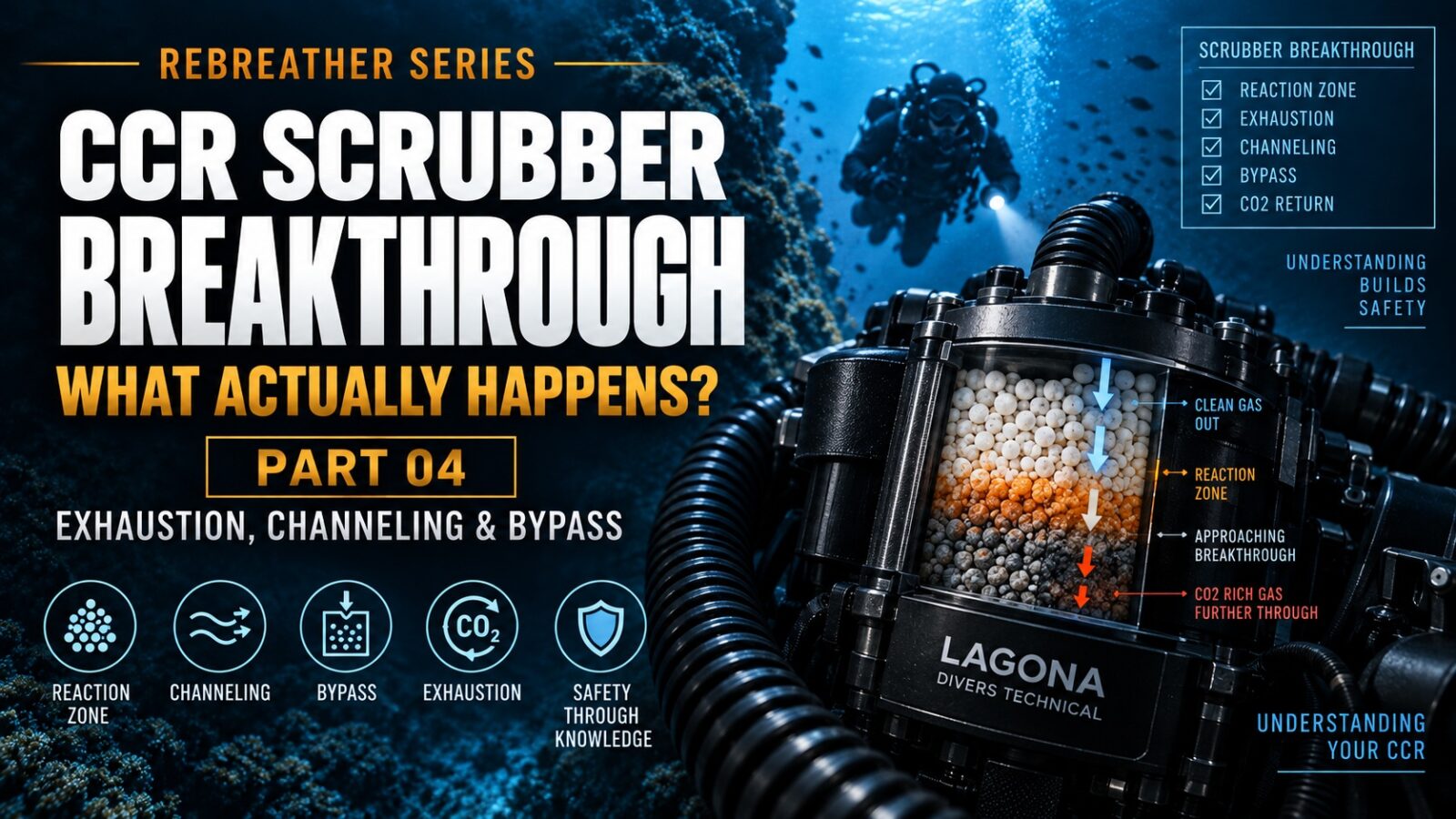
CCR scrubber breakthrough occurs when the scrubber no longer removes carbon dioxide adequately before the breathing gas returns toward the diver. That does not necessarily mean that every part of the absorbent is completely exhausted. Breakthrough can result from progressive absorbent exhaustion, from gas travelling through the absorbent bed along an unintended preferential pathway, or from gas bypassing the absorbent bed altogether.
The better question is therefore not simply whether Sofnolime remains inside the canister. It is whether the complete scrubber system is still removing the CO₂ passing through it adequately.
That distinction matters because a CCR scrubber is not just a container filled with absorbent. It is a complete CO₂-removal system in which the chemical condition of the absorbent, the gas flow through the bed and the intended gas path through the assembled scrubber all have to work together.
CCR Scrubber Breakthrough at a Glance
| Mechanism | What happens |
|---|---|
| Absorbent exhaustion | Gas follows the intended path, but sufficient effective chemical capacity is no longer available. |
| Channeling | Gas travels through the absorbent bed along an unintended preferential pathway, reducing effective interaction with active absorbent. |
| Bypass | Gas travels around the intended absorbent bed rather than properly through it. |
| Reaction-zone progression | The active region of CO₂ absorption moves through the absorbent as chemical capacity is progressively consumed. |
| Gas flow | Active absorbent is only useful if CO₂-containing gas reaches it and interacts with it effectively. |
The central idea is that CCR scrubber breakthrough is a performance problem, not simply a time problem. Part 03 looked at how scrubber duration is managed. Part 04 looks at what is actually happening when CO₂ removal itself becomes inadequate.
What Does CCR Scrubber Breakthrough Actually Mean?
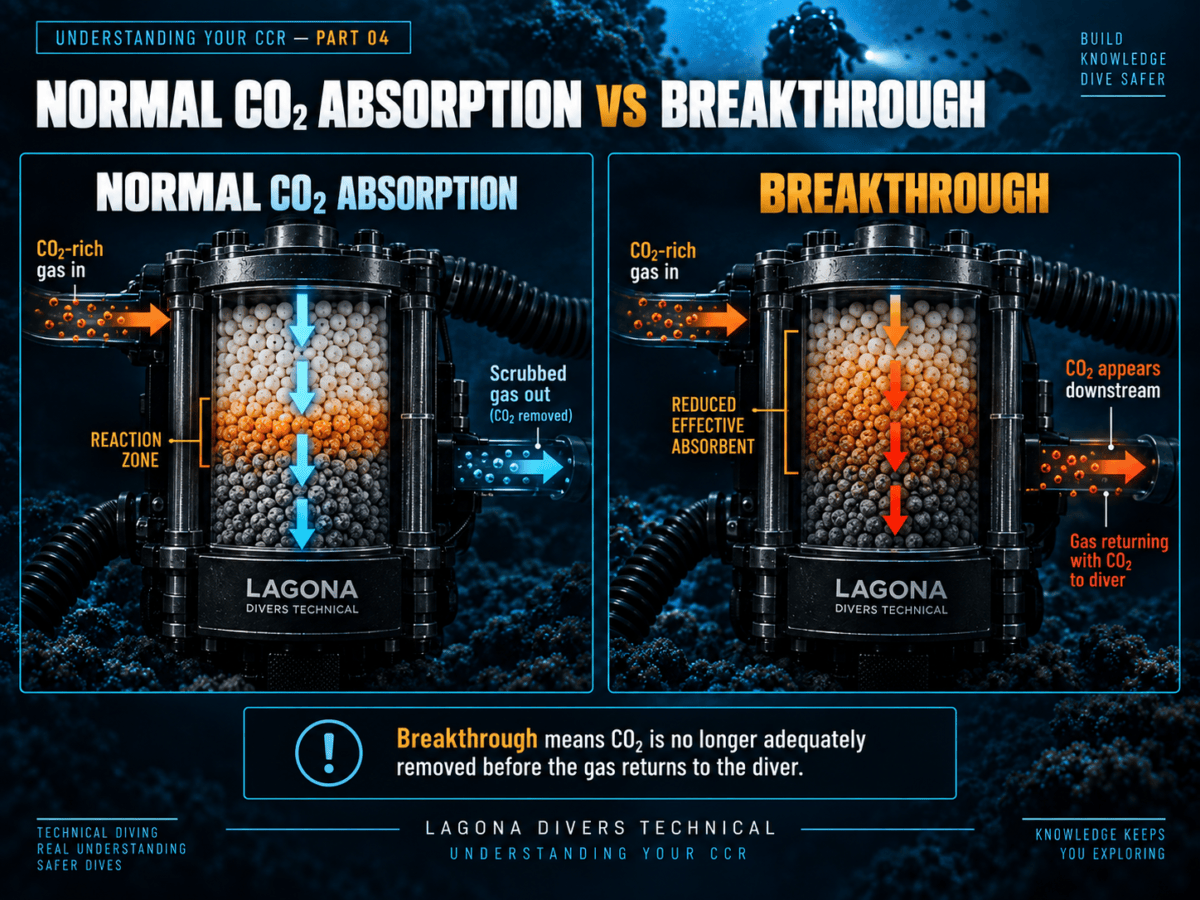
During normal CCR operation, the diver exhales metabolically produced carbon dioxide into the breathing loop. That gas passes through the scrubber before returning toward the diver, and the purpose of the scrubber is to remove the CO₂ from the circulating breathing gas.
Scrubber breakthrough means that carbon dioxide passes through the scrubber without being removed sufficiently. Instead of CO₂-rich gas entering the absorbent bed and adequately scrubbed gas leaving it, measurable or physiologically relevant CO₂ begins appearing downstream of the scrubber.
Breakthrough therefore describes the actual performance of the CO₂-removal system. It does not simply describe how long the scrubber has been used.
That distinction separates this topic from scrubber duration. Duration asks how scrubber use is managed within established limits, while breakthrough asks whether the system is still performing its actual life-support function: adequately removing the CO₂ that enters it.
Does the Entire Scrubber Become Exhausted at Once?
No. A CCR scrubber should not be visualized as though every granule of absorbent changes from fresh to exhausted at exactly the same moment.
As discussed in Part 02, CO₂ removal takes place within an active reaction region inside the absorbent bed. Because the chemical reaction is exothermic, this region also produces heat, and temperature sensors positioned through some rebreather scrubbers can be used to follow the progression of that active region through the absorbent.
CO₂-containing gas reaches one part of the scrubber before another. The absorbent in the incoming gas path therefore begins reacting earlier and progressively loses usable chemical capacity as more carbon dioxide passes through it.
A simplified way to visualize the process is:
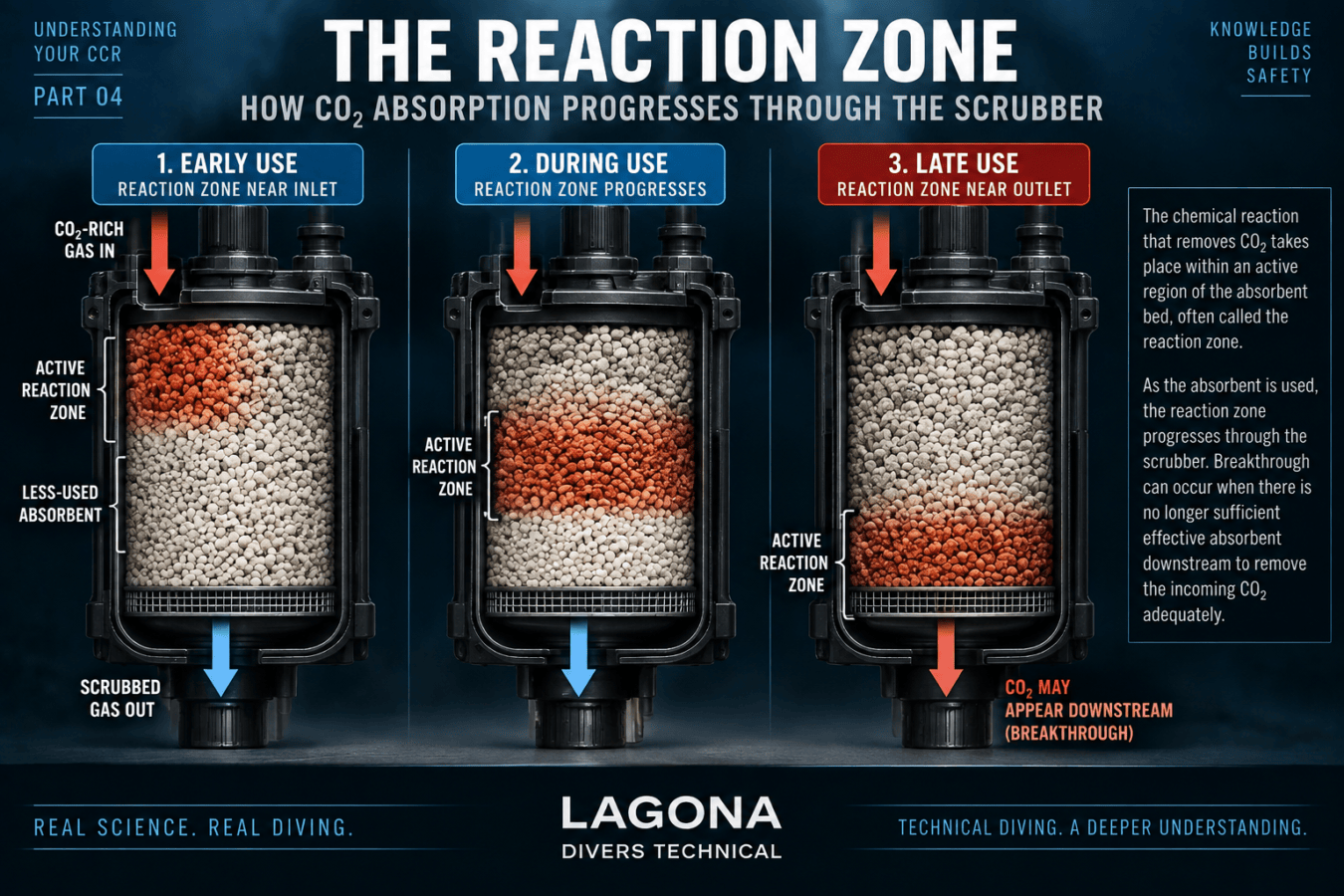
CO₂-rich gas → increasingly used absorbent → active reaction region → less-used absorbent → scrubbed gas
As use continues, the active reaction region progresses farther through the scrubber bed. Eventually there may no longer be enough effective absorbent downstream to remove the incoming CO₂ adequately before the gas reaches the scrubber outlet.
That is breakthrough caused by progressive absorbent exhaustion.
The exact progression depends on the scrubber design, absorbent and operating conditions. It should therefore not be imagined as one universal curve or as a single instant when every part of the absorbent suddenly stops working.
The Reaction Zone and Remaining Absorbent
The movement of the reaction region explains an important point about scrubber performance: breakthrough does not require every part of the absorbent bed to be completely exhausted.
Some areas may still contain useful chemical capacity while the complete scrubber is no longer able to remove enough CO₂ from the gas leaving the canister.
For the diver, the important question is therefore not whether some Sofnolime somewhere in the scrubber remains chemically active. The important question is whether the gas returning from the scrubber has been adequately scrubbed.
This creates a useful distinction:
Remaining absorbent is not the same thing as remaining scrubber performance.
One describes the chemical condition of part of the absorbent bed. The other describes the performance of the complete life-support system.
Why Gas Flow Through the Scrubber Matters
A scrubber cannot remove carbon dioxide simply because active absorbent exists somewhere inside the rebreather. The CO₂-containing gas has to reach that absorbent, and the gas must interact with it effectively enough for the chemical removal process to occur as intended.
A granular scrubber contains thousands of individual absorbent granules with spaces between them. The breathing gas moves through those spaces, and the scrubber is designed so that this flow occurs through the absorbent bed in a controlled way.
If the gas path changes, the amount of active Sofnolime physically present inside the canister may no longer tell the full story.
This leads to two important and different mechanisms: channeling and bypass.
What Is Scrubber Channeling?
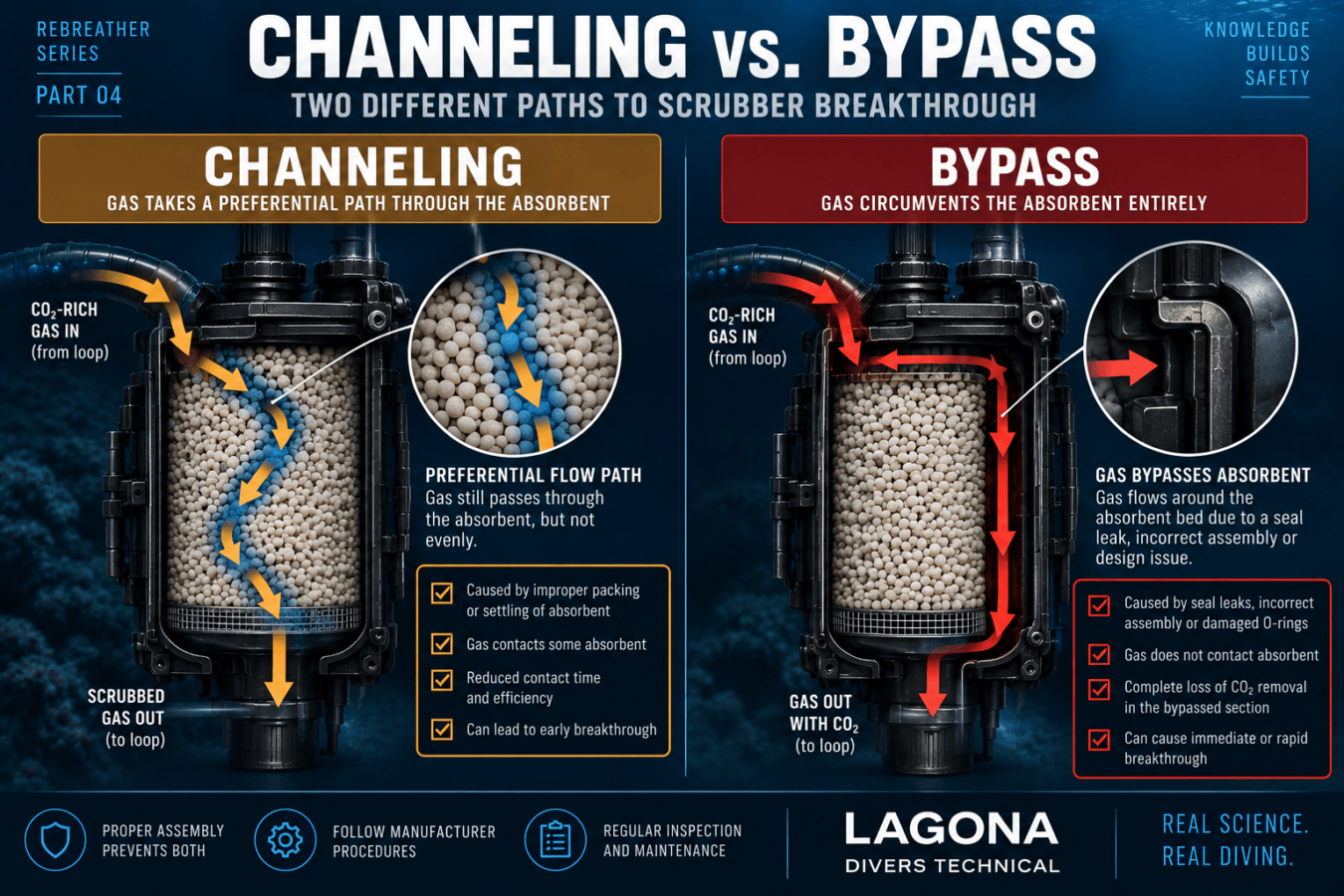
Channeling occurs when part of the breathing gas follows an unintended preferential pathway through the absorbent bed rather than being distributed through it in the way the scrubber design intends.
The gas still passes through the absorbent. It does not completely avoid the scrubber. The problem is that a disproportionate amount of flow may travel along one lower-resistance route, reducing effective contact with the available absorbent elsewhere in the bed.
If that pathway does not provide sufficient interaction between the CO₂-containing gas and active absorbent, the efficiency of CO₂ removal can be reduced.
At the same time, other areas of the canister may remain comparatively underused.
This is another reason why the presence of useful absorbent does not by itself prove that the complete scrubber is performing adequately. A large quantity of Sofnolime can still be present while the gas flow through the bed is no longer using that material effectively.
Why Correct Scrubber Preparation Matters
A granular absorbent bed needs to be prepared according to the procedure established for the specific CCR. The distribution and condition of that bed influence how the breathing gas moves through it.
Voids, uneven packing or other disturbances to the intended structure of the absorbent can alter gas flow. If an unintended pathway with lower resistance develops, more gas may preferentially follow that route instead of being distributed through the bed as designed.
For the diver, the lesson is not to develop personal theories about the perfect packing method. It is to understand why the manufacturer’s preparation procedure exists and to follow the method intended for the actual rebreather being used.
A procedure that is appropriate for one scrubber design should not automatically be transferred to another merely because both systems use granular CO₂ absorbent.
Correct preparation is not simply about making the canister look properly filled. It is about protecting the gas-flow conditions on which the scrubber’s tested performance depends.
What Is Scrubber Bypass?
Bypass is different from channeling. With channeling, the gas still travels through the absorbent bed, but it follows an unintended pathway through it. With bypass, some gas travels around the intended absorbent bed rather than properly through it.
If the assembled scrubber system provides another route around the absorbent, CO₂-containing gas can potentially reach the downstream side without receiving adequate scrubbing. The absorbent itself may still be chemically capable of removing CO₂ and could even be fresh, but fresh absorbent cannot remove CO₂ from gas that does not pass through it.
This is why the scrubber needs to be understood as a complete system rather than simply as a quantity of Sofnolime. Effective CO₂ removal depends on the absorbent, the scrubber canister, the relevant interfaces and seals, and the intended gas path through the system.
If the gas does not pass through the system as intended, active absorbent alone cannot guarantee adequate CO₂ removal.
Exhaustion vs Channeling vs Bypass
These three mechanisms should be kept separate because they describe different ways in which CO₂-removal performance can become inadequate.
With absorbent exhaustion, the breathing gas follows the intended route through the scrubber, but insufficient effective chemical capacity remains.
With channeling, the gas still travels through the absorbent bed, but a preferential pathway reduces the effective interaction between the gas and the available absorbent.
With bypass, gas finds a route around the intended absorbent bed instead of passing through it properly.
The mechanisms are different, but the potential result is the same: carbon dioxide is not removed adequately before the breathing gas returns toward the diver.
Experimental rebreather research has identified absorbent exhaustion, channeling and bypass as distinct mechanisms through which CO₂ breakthrough can occur.
Understanding those differences provides a much better model of scrubber performance than thinking of Sofnolime as simply being either “good” or “finished.”
Can a Scrubber Still Contain Active Sofnolime and Have a CO₂ Problem?
Yes. The physical presence of active absorbent does not prove that the breathing gas is receiving adequate CO₂ removal.
During progressive exhaustion, some regions of the absorbent bed may retain capacity even though the gas leaving the canister is no longer being scrubbed sufficiently.
With channeling, areas of the scrubber can remain comparatively underused because too much gas is following another pathway. With bypass, the absorbent may remain chemically effective while part of the gas avoids the bed entirely.
In each case, the important question is the same: Is the complete scrubber system still adequately removing the carbon dioxide passing through it?
That is more meaningful than simply asking how much Sofnolime appears to remain inside the canister.
Why CCR Scrubber Breakthrough Is Not Simply “The Timer Reached Zero”
Part 03 explained why scrubber duration cannot be reduced to one universal number of hours. The relationship between duration and breakthrough is important, but the two concepts are not interchangeable.
A scrubber runtime limit or logged duration is part of the operational method used to keep scrubber use within established procedures and limitations. A timer does not directly measure every chemical reaction taking place inside the absorbent, nor does it confirm that the breathing gas is following the intended path through the scrubber.
The useful distinction is that scrubber duration describes how scrubber life is managed, while scrubber breakthrough describes what happens when actual CO₂-removal performance becomes inadequate.
Understanding that scrubber performance depends on conditions should make a diver more attentive to the procedures and operating limits established for the specific CCR.
It should not be used as a reason to create personal extensions to those limits.
Why the Gas Path Is Part of the Scrubber
It is easy to think of scrubber performance mainly as a property of the absorbent, but the absorbent is only one part of the system.
For CO₂ removal to occur as intended, breathing gas has to enter the scrubber through the designed route, travel through the absorbent bed effectively, interact with active material and leave without an alternative path allowing inadequately scrubbed gas around the bed.
Gas flow is therefore part of scrubber performance.
This is also why preparation, assembly and installation procedures matter. They are not simply mechanical steps included because the manual requires them. They protect the gas-flow conditions needed for the scrubber to perform its life-support function.
A knowledgeable CCR diver should understand not only what those procedures are, but also what type of failure they are intended to help prevent.
What Happens When CO₂ Gets Through the Scrubber?
During normal operation, the diver exhales carbon dioxide into the breathing loop, the gas passes through the scrubber, the CO₂ is removed and the scrubbed breathing gas continues around the loop.
During breakthrough, that sequence changes. The scrubber no longer removes enough of the incoming carbon dioxide, so some CO₂ remains in the circulating gas and can return toward the diver.
At that point, the problem begins to move from the rebreather into the diver.
Adding oxygen does not remove carbon dioxide. Maintaining the intended oxygen partial pressure also does not compensate for inadequate CO₂ removal.
A CCR can therefore have an oxygen-control system that appears to be functioning normally while the scrubber is no longer performing its separate job adequately.
This is an important systems distinction: PPO₂ control and CO₂ removal are different life-support functions.
If the scrubber allows carbon dioxide to remain in the inspired breathing gas, the diver may begin rebreathing metabolically produced CO₂. What happens physiologically after that is the subject of Part 05.
Is Scrubber Breakthrough the Same as Hypercapnia?
No. The two terms describe different parts of the same potential problem.
Scrubber breakthrough describes what is happening inside the rebreather: carbon dioxide is passing through the scrubber without being removed sufficiently.
Hypercapnia describes what is happening physiologically in the diver: the level of carbon dioxide in the body has become abnormally elevated.
Scrubber breakthrough can contribute to hypercapnia because inadequately scrubbed gas may cause the diver to rebreathe CO₂. Hypercapnia, however, is a broader physiological subject and can involve factors beyond simple scrubber breakthrough.
What Should a CCR Diver Learn From Scrubber Breakthrough?
A CCR scrubber needs more than active absorbent. It needs a complete system in which the absorbent, scrubber canister, seals, interfaces and gas path work together as intended.
Progressive absorbent exhaustion can eventually allow carbon dioxide through even when some usable absorbent remains elsewhere in the bed. Channeling can reduce effective contact between the gas and the absorbent, while bypass can allow gas to avoid the intended absorbent bed altogether.
These mechanisms are different, but they all lead back to the same requirement: the CO₂ produced by the diver must be adequately removed before the breathing gas returns to the diver.
Understanding CCR scrubber breakthrough is therefore not simply about memorizing another technical definition. It explains why scrubber preparation, correct assembly and operating procedures exist in the first place.
For divers entering CCR or developing their rebreather knowledge further, that distinction matters. Good training should not merely teach the correct procedure; it should help the diver understand what failure mechanism that procedure is designed to prevent.
Frequently Asked Questions
What is CCR scrubber breakthrough?
CCR scrubber breakthrough occurs when CO₂ passes through the rebreather scrubber without being adequately removed before the breathing gas returns toward the diver.
Does breakthrough mean all the Sofnolime is completely exhausted?
No. Progressive exhaustion can result in breakthrough before every part of the absorbent bed is completely exhausted. Inadequate CO₂ removal can also result from gas-flow problems such as channeling or bypass.
What is scrubber channeling?
Channeling occurs when part of the gas takes an unintended preferential route through the absorbent bed. This can reduce effective interaction between the breathing gas and active absorbent.
What is the difference between channeling and bypass?
With channeling, gas travels through the absorbent bed but along an unintended pathway. With bypass, gas travels around the intended absorbent bed rather than properly through it.
Can fresh Sofnolime still be involved in a CO₂-removal problem?
Potentially. Active absorbent cannot remove CO₂ from gas that does not interact with it adequately. Channeling or bypass can therefore compromise CO₂ removal even when useful absorbent remains.
Is scrubber breakthrough the same as hypercapnia?
No. Scrubber breakthrough describes inadequate CO₂ removal by the rebreather, while hypercapnia describes abnormally elevated CO₂ in the diver. Breakthrough can contribute to hypercapnia because CO₂ may be rebreathed.
Understand Your CCR — Not Just the Scrubber Timer
Knowing how long a scrubber may be used is important, but understanding why the scrubber removes CO₂ and what can cause that removal to become inadequate is something different.
Scrubber performance depends on more than absorbent simply being present inside a canister. The absorbent needs sufficient chemical capacity, the breathing gas has to travel through it as intended, and the assembled system must prevent gas from taking an alternative path around the absorbent bed.
That knowledge should not encourage a diver to experiment with the boundaries of scrubber performance. It should make the procedures and limits established for the CCR easier to understand and more meaningful to follow.
At Lagona Divers Technical, we approach CCR training with that same philosophy. Training should not simply teach a sequence of procedures or tell the diver how to assemble a scrubber. It should help the diver understand the equipment, recognize its limitations, develop the necessary skills and understand which failure mechanisms those procedures are designed to prevent.
Once you understand the difference between absorbent exhaustion, channeling and bypass, the scrubber stops being simply a canister full of Sofnolime. It becomes what it actually is: a complete CO₂-removal system whose chemistry, gas flow and physical assembly all have to work together.
Explore CCR training with Lagona Divers Technical in the Red Sea or contact us to discuss the right rebreather training pathway for your experience and diving goals.