How Does a CCR Work? A Simple Guide to Closed-Circuit Rebreathers
Did you wonder how does a CCR work? A closed-circuit rebreather, or CCR, recycles the diver’s breathing gas instead of releasing each exhaled breath into the water. The system removes the carbon dioxide produced by the diver, replaces the oxygen that has been consumed, and circulates the processed gas back around the breathing loop to be breathed again.
That is the basic principle. The equipment may look considerably more complicated than open-circuit scuba, but the underlying process becomes much easier to understand when you stop looking at the rebreather as one machine and instead follow what happens to a single breath.
A CCR is essentially solving two continuous problems created by the diver’s metabolism: you consume oxygen, and you produce carbon dioxide. The rebreather has to deal with both before the breathing gas can be safely reused.
How a CCR Works at a Glance
| What happens | What the CCR has to do |
|---|---|
| The diver inhales breathing gas | Supply gas from the breathing loop |
| The body consumes oxygen | Replace the oxygen that was metabolized |
| The body produces CO₂ | Remove CO₂ from the loop |
| The diver exhales | Keep the gas inside the system instead of discarding it |
| Pressure and loop volume change | Add or release gas as required |
| The gas has been processed | Circulate it back to the diver |
The easiest way to understand the entire system is to compare it first with open-circuit scuba.
What Happens When You Breathe Open Circuit?
With normal open-circuit scuba, you inhale gas supplied from the cylinder through the regulator. Your body takes up some of the oxygen contained in that breath and produces carbon dioxide as part of normal metabolism.
When you exhale, almost the entire breath is released into the surrounding water as bubbles. The gas travels from the cylinder to the diver and then leaves the breathing system completely, which is why it is called open circuit.
Your body does not consume the entire gas volume you inhale. It uses only part of the oxygen, while much of the remaining gas is simply exhaled. Open-circuit scuba does not attempt to recover that gas; every breath is supplied once and then discarded.
A closed-circuit rebreather takes a fundamentally different approach. Instead of throwing the exhaled gas away, it keeps that gas inside a breathing loop and processes it so that it can be breathed again.
What Does a Closed-Circuit Rebreather Do Differently?
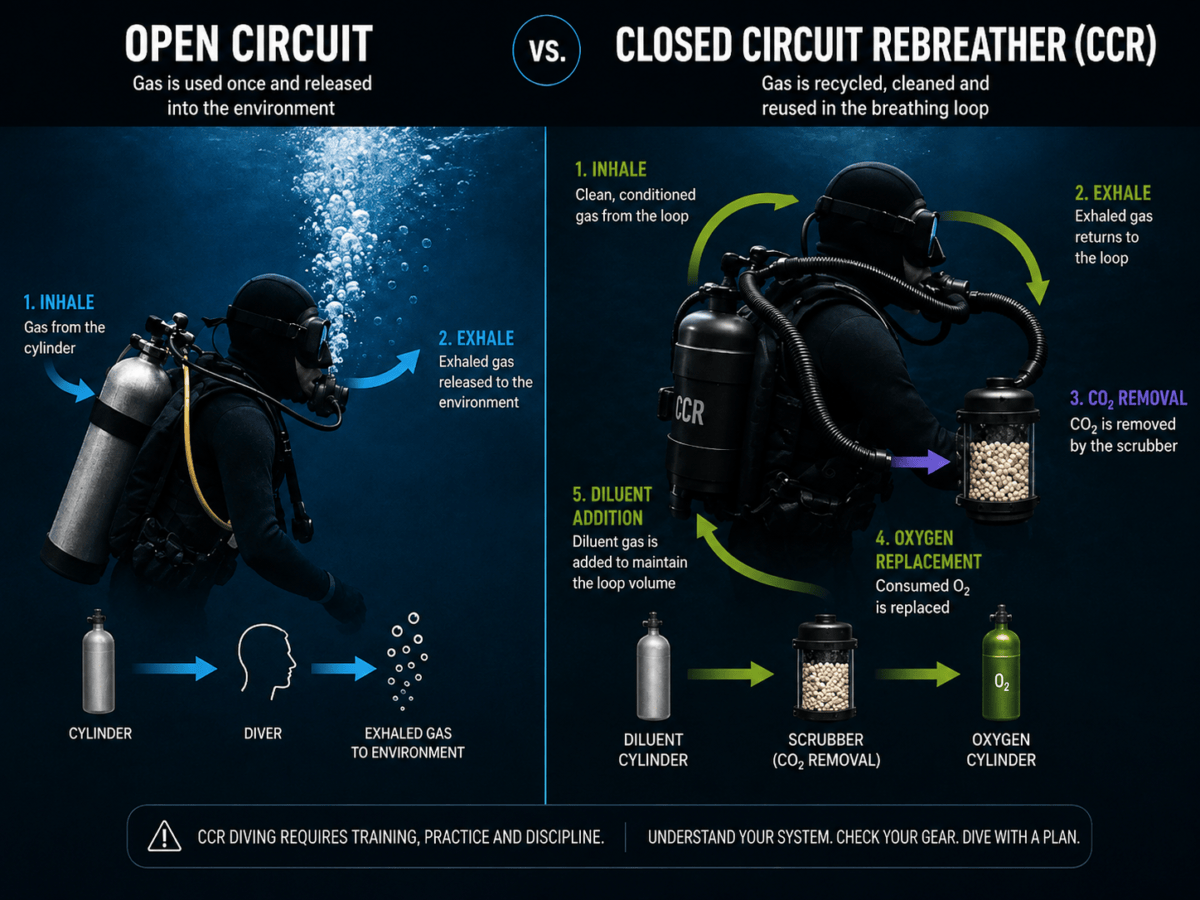
When you exhale into a CCR, the gas returns to the rebreather rather than being released directly into the water. Before that gas can come back to you, the system has to correct the changes your body made to it.
The exhaled gas contains more carbon dioxide because your metabolism produced CO₂. It also contains less oxygen because your body consumed some of the oxygen that was available.
The CCR therefore has two essential jobs:
- remove the carbon dioxide
- replace the oxygen that has been consumed
Once those two processes are understood, the basic operation of a closed-circuit rebreather becomes much less mysterious.
Let’s Follow One Breath Around a CCR
A CCR breathing loop forms a closed gas pathway between the diver and the rebreather. Instead of gas travelling from a cylinder to the diver and then disappearing into the water, it circulates continuously through the system.
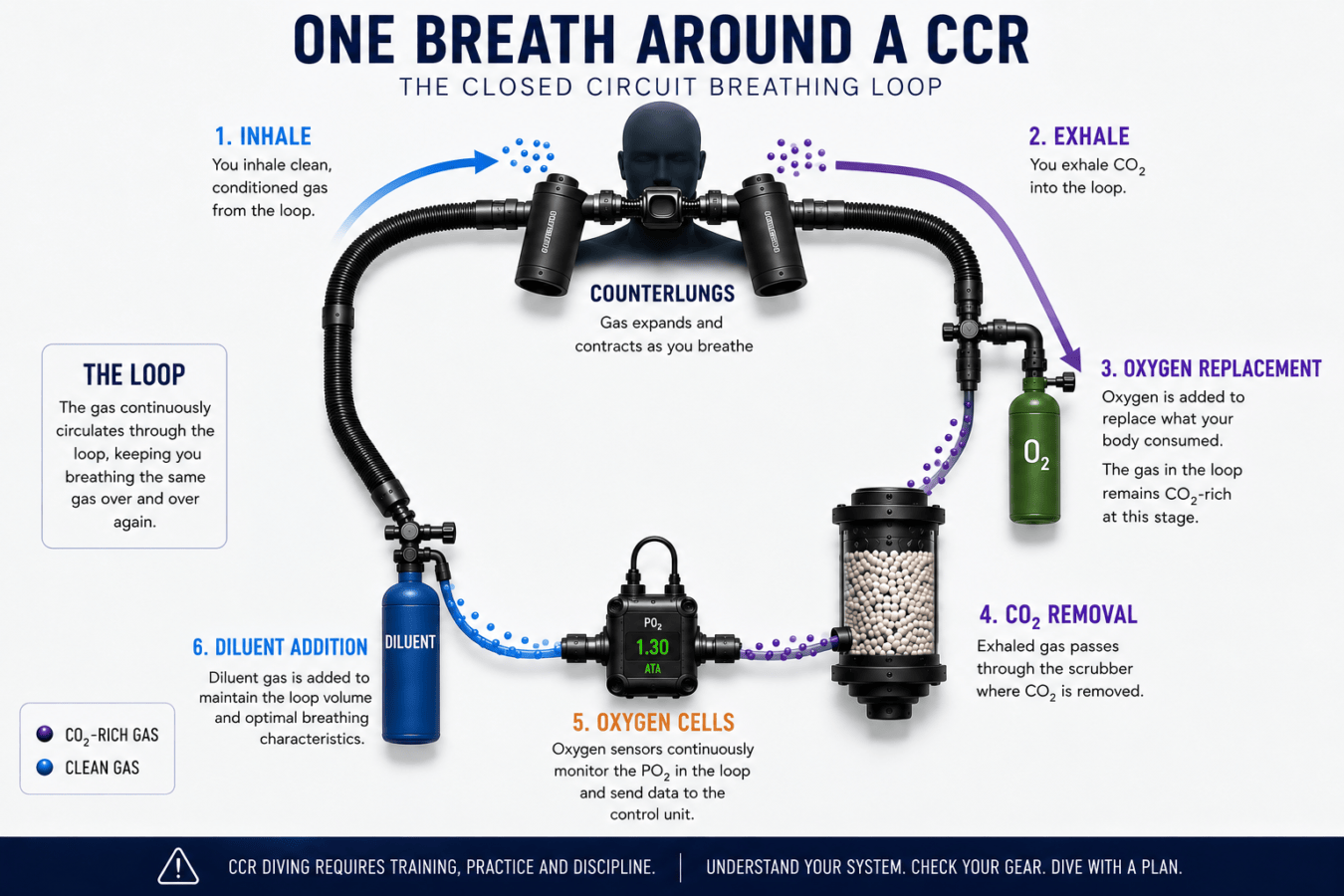
Step 1: You Inhale Gas From the Breathing Loop
When you inhale from a CCR, the gas comes from the breathing loop rather than directly from a cylinder through a conventional second-stage regulator.
The loop includes components such as the breathing hoses, mouthpiece, counterlungs and scrubber. One-way valves help ensure that the gas travels through the loop in the intended direction instead of simply moving backwards and forwards through the same hose.
The gas leaves the inhalation side of the loop, passes through the mouthpiece and enters your lungs.
Step 2: Your Body Changes the Gas
Inside your lungs, your body takes up oxygen for metabolism. At the same time, carbon dioxide produced by metabolism enters the exhaled gas.
The gas leaving your lungs is therefore no longer exactly the same gas you inhaled. It contains less oxygen and more carbon dioxide.
On open circuit, that changed gas would simply be released into the water. In a CCR, it remains part of the breathing system.
Step 3: You Exhale Back Into the Rebreather
When you exhale, the gas travels through the exhalation side of the breathing loop and returns to the rebreather.
At this point, the main immediate problem is the carbon dioxide that has been added by the diver. CO₂ cannot simply be allowed to accumulate in a closed breathing system, so the exhaled gas must pass through the scrubber before it can be returned to the diver.
Step 4: The Scrubber Removes CO₂
The scrubber contains a carbon-dioxide absorbent, commonly a diving-grade soda lime such as Sofnolime. As the exhaled gas passes through the scrubber material, CO₂ is removed through a chemical reaction.
The scrubber is therefore not simply a physical filter that traps carbon dioxide between granules. The absorbent reacts chemically with the CO₂ and removes it from the circulating breathing gas.
Once the gas has passed through the scrubber, one of the two metabolic changes created by the diver has been addressed.
The second remains: oxygen has been consumed.
Step 5: The CCR Replaces Metabolized Oxygen
If the rebreather simply continued circulating the same gas without adding oxygen, the available oxygen in the breathing loop would progressively decrease as the diver continued to metabolize it.
A CCR therefore has an oxygen supply that allows oxygen to be added back into the breathing loop. The objective is to replace the oxygen consumed by the diver and maintain the required oxygen conditions in the loop.
How oxygen addition is controlled depends on the design of the rebreather. Some systems use electronic control as part of that process, while the diver also has responsibilities for monitoring and operating the unit.
At system level, however, the principle is simple:
your body removes oxygen from the breathing loop, so the CCR has to replace it.
Step 6: The Processed Gas Returns to the Diver
Once carbon dioxide has been removed and oxygen has been managed appropriately, the gas continues around the loop and becomes available for the next inhalation.
The same gas volume is therefore being circulated and processed repeatedly rather than discarded after every breath.
The cycle continues for as long as the system is operating:
inhale → metabolize oxygen and produce CO₂ → exhale → remove CO₂ → replace oxygen → inhale again
That continuous recycling process is the fundamental difference between closed-circuit rebreather diving and open-circuit scuba.
What Is the Breathing Loop?
The breathing loop is the closed gas pathway connecting the diver to the rebreather.
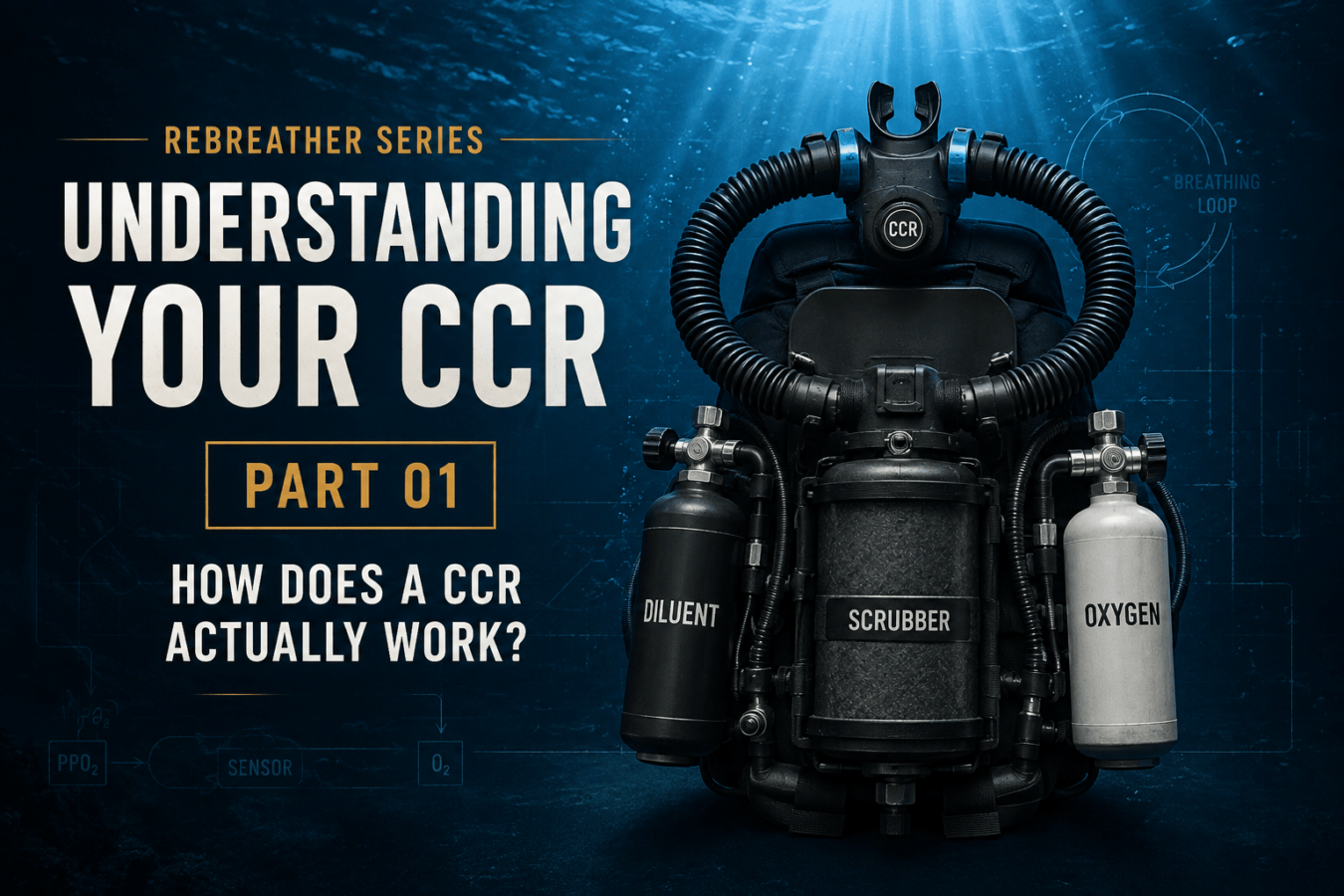
It includes the mouthpiece, breathing hoses, counterlungs and the internal gas path through components such as the scrubber. Depending on the unit, the physical arrangement of these components can differ considerably, but their combined purpose is to allow breathing gas to circulate through the system.
One-way valves in the mouthpiece or breathing-loop assembly help maintain the intended direction of gas flow. Without directional control, the diver could simply move the same gas backwards and forwards rather than circulating it correctly through the scrubber and the rest of the breathing loop.
The loop is therefore more than a pair of hoses. It is the complete gas pathway through which the rebreather performs its basic life-support functions.
What Does the Scrubber Do?
The scrubber removes carbon dioxide from the gas exhaled by the diver.
This is essential because, unlike open circuit, the exhaled gas is not immediately discarded. Without effective CO₂ removal, carbon dioxide produced by the diver would remain in the loop and could accumulate as the gas continued to circulate.
The scrubber contains an absorbent material through which the exhaled gas passes. Its job is to chemically remove CO₂ before that gas is returned to the inhalation side of the system.
For understanding the CCR as a whole, that is the important point:
the diver produces CO₂, and the scrubber removes it from the breathing loop.
Why Does a CCR Need an Oxygen Cylinder?
The oxygen cylinder supplies the oxygen needed to replace what the diver metabolizes.
This is fundamentally different from open circuit. On open circuit, every inhalation brings in a completely new breath of cylinder gas. A CCR retains most of the breathing gas already present in the loop, so it does not need to replace the entire breath. It needs to replace the oxygen the diver actually consumed, together with any gas lost or added for other reasons.
That is one of the reasons rebreathers can use breathing gas so efficiently.
The oxygen supply is therefore not simply another cylinder attached to the unit. It performs a specific metabolic replacement function within the closed breathing system.
How Does the CCR Know What the Oxygen Level Is?
CCR systems use oxygen sensors to provide information about the oxygen partial pressure, or PPO₂, in the breathing loop.
At this level, it is enough to understand that the sensors provide the rebreather and the diver with information about oxygen conditions in the loop. Depending on the CCR design, that information may also be used by an electronic control system as part of managing oxygen addition.
The important distinction is that the rebreather is not simply trying to maintain a fixed oxygen percentage. CCR operation is based heavily on oxygen partial pressure, which is why PPO₂ is such a central measurement in rebreather diving.
The detailed sensor chemistry and the relationship between oxygen fraction, pressure and PPO₂ do not need to be understood in order to grasp the basic breathing cycle.
What Is Diluent For?
A CCR normally carries a second gas supply known as diluent.
Oxygen and diluent have different functions. Oxygen replaces oxygen consumed by the diver, while diluent provides breathing gas that can be added to the loop as pressure, loop volume and breathing-gas requirements change.
During descent, ambient pressure increases and the gas spaces inside the breathing loop are compressed. Without additional gas, the loop volume would become progressively smaller and breathing would become difficult or impossible. Adding diluent allows usable loop volume to be restored as pressure increases.
Diluent also contributes to the composition of the breathing gas. The appropriate diluent depends on the type and depth of diving, but the important system-level distinction is straightforward:
oxygen replaces metabolized oxygen; diluent serves a different role in maintaining and managing the breathing loop.
What Are the Counterlungs?
The counterlungs provide flexible gas volume within the breathing loop.
When you inhale, gas leaves the rebreather loop and enters your lungs, so the counterlungs reduce in volume. When you exhale, gas returns from your lungs to the rebreather and the counterlungs expand again.
They therefore act as part of the breathing-volume system that allows gas to move backwards and forwards between the diver’s lungs and the rebreather while still circulating through a closed loop.
The exact position and configuration of counterlungs vary between CCR designs, but the basic function remains the same: they provide flexible volume for the breathing gas while the diver inhales and exhales.
Putting It Together: One Complete Breath Around the CCR
The entire process can now be viewed as one continuous system.
You inhale gas from the breathing loop. Your body consumes some of its oxygen and adds carbon dioxide. You then exhale that gas back into the CCR instead of releasing it into the water.
The exhaled gas travels through the system, where the scrubber removes the carbon dioxide. Oxygen can be added to replace what your metabolism has consumed, while diluent and other gas-management functions help maintain appropriate loop volume and composition as conditions change.
The processed gas returns to the inhalation side of the loop and becomes available for another breath.
Then the process repeats.
That is how a closed-circuit rebreather works at its most fundamental level.
Why Does a CCR Produce So Few Bubbles?
An open-circuit diver releases almost every exhaled breath into the surrounding water. Because a CCR recycles the breathing gas, it does not normally release a complete exhaled breath every few seconds.
This is why CCR divers produce far fewer bubbles and why rebreathers can be much quieter underwater.
Closed circuit does not mean that gas can never leave the system. Gas may still need to be released as loop volume changes, particularly during ascent, and gas can also be lost or vented as part of normal operation and diver procedures.
The difference is that discarding the entire exhaled breath is not the normal breathing cycle.
Why Is a CCR So Gas Efficient?
On open circuit, every breath must be supplied from a cylinder. At greater ambient pressure, more gas molecules are required to provide the same physical breathing volume, and that entire breath is then exhaled into the water.
A CCR recycles most of the gas already present in the loop. Instead of continuously replacing the whole breathing volume, the system primarily needs to replace oxygen consumed by the diver, compensate for pressure and volume changes, and replace gas that is otherwise lost.
This creates one of the major operational advantages of rebreather technology, particularly where gas logistics become significant.
The efficiency is not free, however. Reusing breathing gas requires the system to continuously manage carbon dioxide, oxygen, loop volume and the integrity of the breathing circuit. A CCR is therefore more gas-efficient precisely because it takes on functions that open-circuit equipment does not have to perform.
Is a CCR an Automatic Breathing Machine?
No.
A modern CCR may contain sophisticated sensors, electronics, displays and control systems, but these do not remove the need for an informed and actively involved diver.
The diver has to understand the equipment, monitor the information the unit provides, follow the appropriate procedures and recognise when the behaviour of the system does not match expectations.
This is why CCR training cannot be reduced to learning which buttons to press. The equipment is a life-support system, and using it competently requires an understanding of what its major components are doing and why those functions matter.
A CCR Is Easier to Understand as Several Systems Working Together
The rebreather becomes much easier to understand when each component is connected to the problem it solves.
You produce carbon dioxide.
The scrubber removes it.
You consume oxygen.
The oxygen supply replaces it.
The system needs information about oxygen conditions.
Oxygen sensors provide PPO₂ information.
Breathing gas needs space to move as you inhale and exhale.
The breathing loop and counterlungs provide that volume.
Ambient pressure changes during the dive.
Diluent and loop management allow the breathing system to accommodate those changes.
A CCR may look complex because all of these systems are combined into one piece of life-support equipment. Individually, however, each function solves a clear physical or physiological problem.
So, How Does a CCR Work?
A closed-circuit rebreather recycles the diver’s breathing gas instead of discarding each exhaled breath.
The diver consumes oxygen and produces carbon dioxide. The scrubber removes CO₂ from the exhaled gas, the system replaces the oxygen that has been metabolized, and diluent helps maintain the breathing loop as pressure and operating conditions change. Counterlungs provide flexible breathing volume, while oxygen sensors provide information about oxygen partial pressure in the loop.
The processed gas then circulates back to the diver and is breathed again.
Understanding that basic cycle provides the foundation for understanding the rest of the rebreather. The individual components may be technically sophisticated, but they are all working together to solve the same basic problem: keep the breathing gas usable while it remains inside a closed system.
Frequently Asked Questions
How does a CCR work?
A CCR recycles the diver’s breathing gas rather than releasing every exhaled breath into the water. Carbon dioxide is removed by the scrubber, oxygen is added to replace what the diver consumes, and the processed gas circulates back around the breathing loop.
What does CCR stand for in diving?
CCR stands for Closed-Circuit Rebreather. The term describes a breathing system that retains and recirculates the diver’s breathing gas rather than routinely exhausting the entire breath into the environment.
Does a CCR recycle the same gas forever?
No. The gas inside the loop is continually changing. The diver consumes oxygen and produces CO₂, the rebreather removes CO₂ and adds oxygen, and gas can also be added or released as pressure, loop volume and operating conditions change.
What removes CO₂ from a rebreather?
A scrubber containing CO₂ absorbent removes carbon dioxide from the breathing loop through a chemical reaction. Diving-grade soda lime such as Sofnolime is commonly used for this purpose.
Why does a CCR need both oxygen and diluent?
They perform different functions. Oxygen replaces the oxygen consumed by the diver, while diluent is used as part of managing breathing-gas composition and maintaining usable loop volume as pressure and operating conditions change.
Why does a CCR use oxygen sensors?
Oxygen sensors provide information about the oxygen partial pressure in the breathing loop. This allows the diver, and depending on the design the CCR control system, to monitor oxygen conditions.
Does a CCR make no bubbles?
No. CCRs normally produce far fewer bubbles because they recycle breathing gas instead of discarding every exhaled breath. Gas can still be released from the loop during normal operation and as pressure changes during the dive.
Is CCR diving just more efficient scuba?
No. Gas efficiency is one advantage of a CCR, but it is achieved by recycling and actively managing the breathing gas. That introduces additional equipment, monitoring requirements, procedures and responsibilities compared with open circuit.
Want to Understand Your Rebreather, Not Just Operate It?
CCR training isn’t simply about learning a sequence of procedures. The objective should be to understand the equipment, recognize its limitations, develop the necessary skills and understand why the procedures exist.
At Lagona Divers Technical, we approach rebreather training with that principle in mind: developing knowledgeable, capable CCR divers rather than simply teaching someone how to operate a unit.
Explore CCR training with Lagona Divers Technical in the Red Sea or contact us to discuss the right rebreather training pathway for your experience and diving goals.