How Does a Rebreather Scrubber Work? CO₂ Explained
IIf you dive a closed-circuit rebreather, you may already know the basic answer to the question how does a rebreather scrubber work? It removes carbon dioxide from the breathing loop, but what is actually happening inside the scrubber canister? Where does the CO₂ go, why does the absorbent become warm, and why does Sofnolime eventually reach the end of its usable capacity?
The key idea is that a CCR scrubber does not simply filter carbon dioxide from the breathing gas. It removes CO₂ through a chemical process that takes place as exhaled gas passes through the absorbent bed.
In a scrubber filled with Sofnolime, carbon dioxide reacts with the soda-lime absorbent and is ultimately incorporated mainly into calcium carbonate. At the same time, heat is released and the reactive capacity of the absorbent is gradually consumed.
Understanding that process helps explain several things CCR divers already deal with in practice, including scrubber duration, heat production, reaction zones, packing, breakthrough, workload and water management.
If you have not read Part 01 of this series, start with How Does a CCR Work? before continuing deeper into the scrubber.
Why Does a CCR Need a CO₂ Scrubber?
A diver’s body continuously consumes oxygen and produces carbon dioxide as part of normal metabolism. On open circuit, the gas that the diver exhales is released into the surrounding water, so the carbon dioxide leaves with each exhalation.
A closed-circuit rebreather works differently because most of the breathing gas remains inside the loop and is circulated back to the diver. The CCR therefore has to deal continuously with two metabolic changes: oxygen is being removed from the breathing gas by the diver, while carbon dioxide is being added to it.
The rebreather replaces the metabolically consumed oxygen and removes the metabolically produced carbon dioxide. The scrubber performs the second of those jobs by chemically removing CO₂ before the breathing gas returns to the diver.
Without effective carbon dioxide removal, CO₂ would progressively accumulate in the breathing loop. The scrubber is therefore not simply a filter placed somewhere in the system; it is one of the fundamental life-support components of a CCR.de removal, CO₂ would progressively accumulate in the breathing loop. The scrubber is therefore not an optional filtration component. It is part of the CCR’s life-support system.
What Is Sofnolime in a Rebreather Scrubber?
Sofnolime is a commercial soda-lime carbon dioxide absorbent used in recirculating breathing systems, including diving rebreathers.
Diving grades consist of granular chemical absorbent whose chemistry is based primarily around calcium hydroxide, water and smaller quantities of strong alkali that facilitate the removal of carbon dioxide.
For a CCR diver, it is more useful to think of the scrubber as a chemical processing bed than as a conventional filter. The breathing gas physically passes through the spaces between the absorbent granules, but the CO₂ is not removed simply because it becomes trapped between them.
Instead, carbon dioxide enters a chemical process within the moist absorbent. The size and geometry of the granules, the design of the scrubber and the way the bed is packed all influence how effectively the breathing gas comes into contact with active absorbent.
For that reason, divers should use the absorbent type and grade specified or approved by the manufacturer of their particular rebreather rather than assuming that all soda lime behaves identically in every scrubber design.
How Does a Rebreather Scrubber Work?
The process begins when CO₂-rich exhaled gas enters the scrubber canister and flows through the soda-lime bed. The absorbent contains the chemical ingredients and moisture required for carbon dioxide removal, and the reaction takes place progressively as the gas passes through the active material.
The important point is that carbon dioxide does not simply disappear from the loop. It is chemically transformed and becomes part of the reaction products inside the scrubber.
Where Does the CO₂ Actually Go?
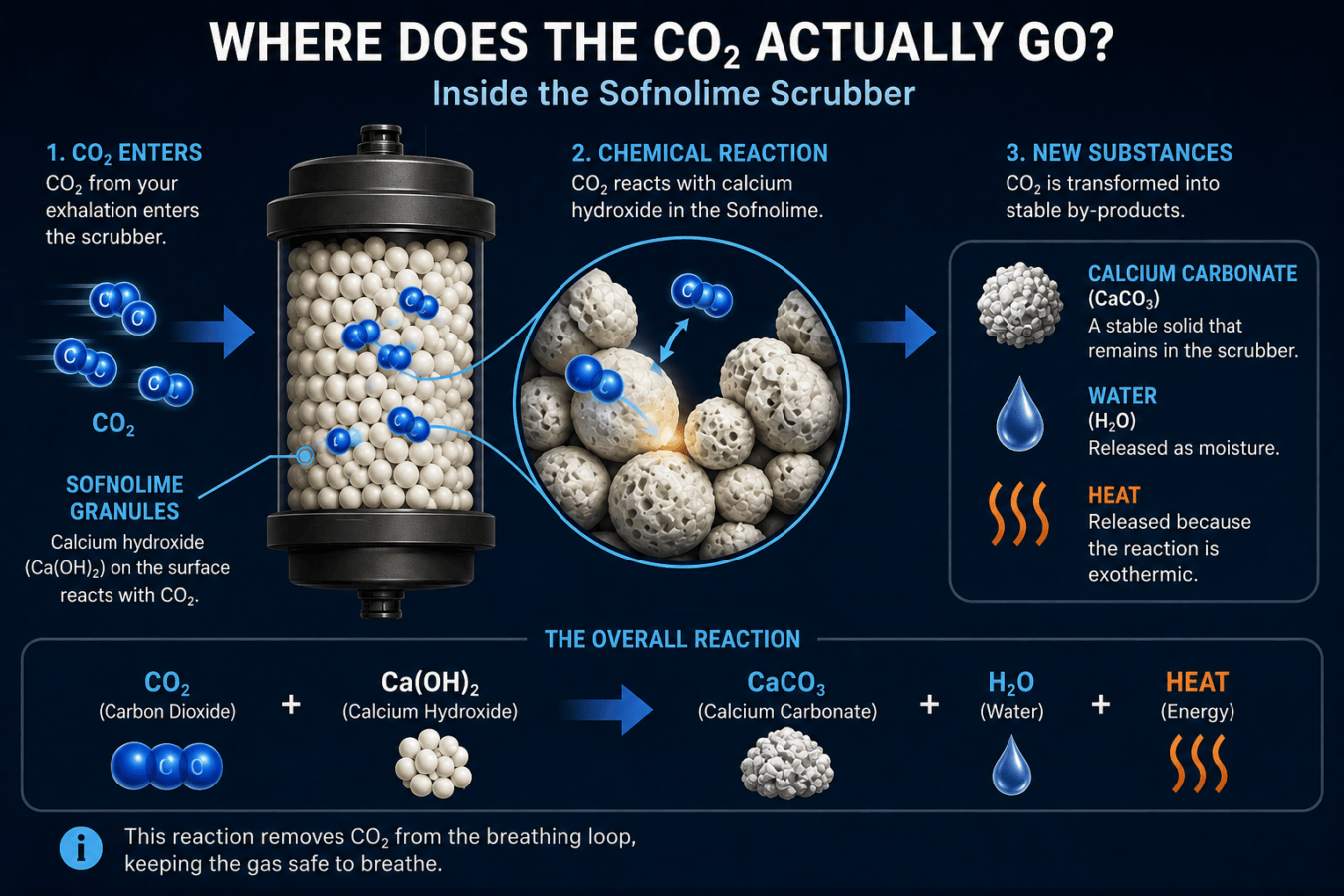
As exhaled carbon dioxide reaches the moist environment associated with the soda-lime granules, it enters the aqueous layer within the absorbent and participates in a series of reactions in which the alkaline components facilitate CO₂ removal.
For practical CCR understanding, the overall process is commonly simplified to:
CO₂ + Ca(OH)₂ → CaCO₃ + H₂O + heat
The exact chemical pathway involves several intermediate steps, but the important product for the diver to understand is calcium carbonate.
The CO₂ has therefore not simply been physically captured somewhere inside the scrubber. It has participated in a chemical reaction, and active absorbent material has been consumed in that process.
This is the first reason scrubber capacity is finite. There is only a limited amount of reactive material available inside the canister.
Why Does a Rebreather Scrubber Get Warm?
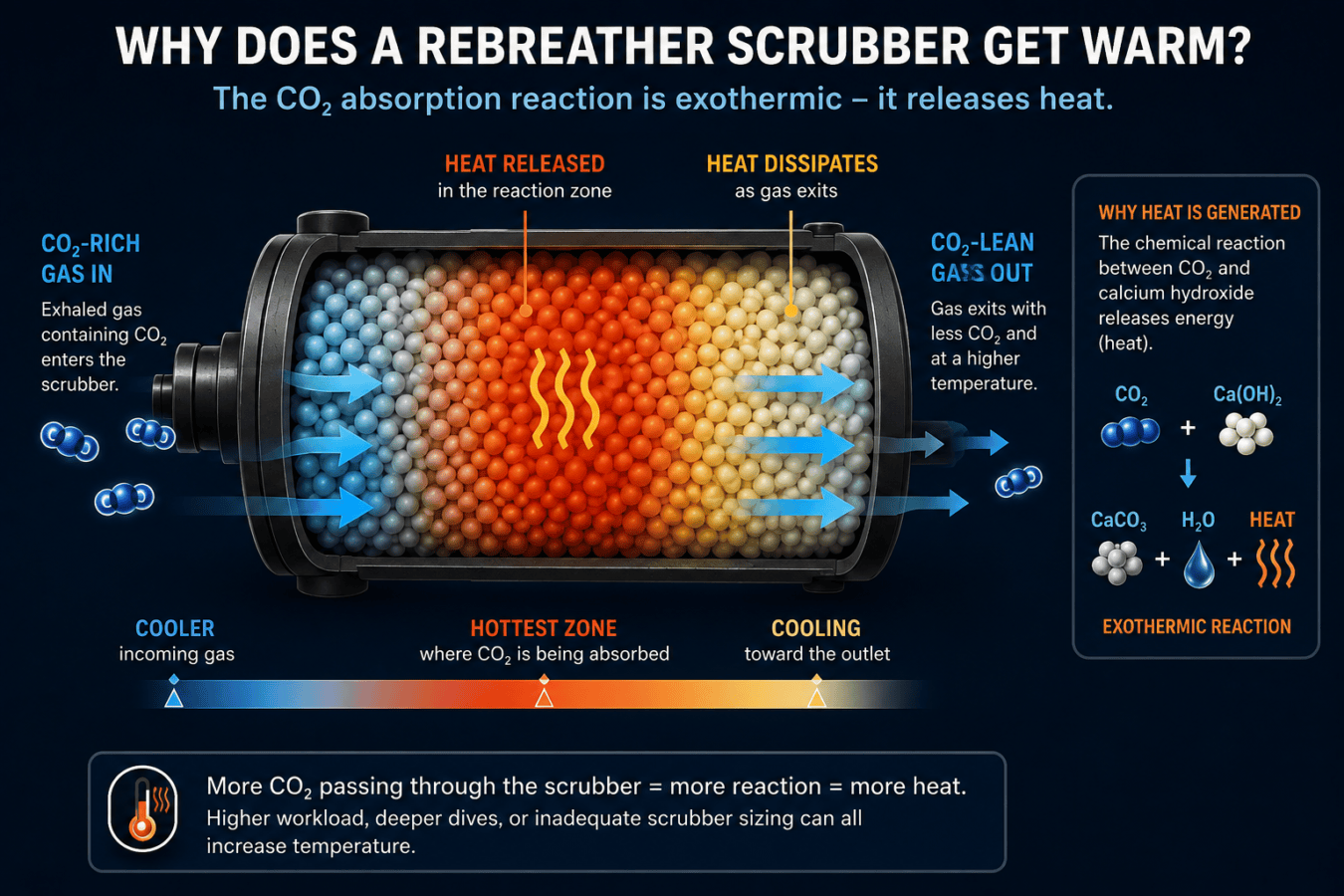
The reaction involved in carbon dioxide absorption is exothermic, which means that it releases heat. As CO₂ is removed from the breathing gas, the region of the scrubber in which the reaction is actively taking place therefore becomes warmer.
This is why a working scrubber can develop a detectable temperature pattern during use. Some rebreather designs can use temperature information to provide insight into the progression of the active reaction region through the absorbent bed.
The presence of heat, however, should not be interpreted as a way for the diver to create an independent scrubber-duration rule. Manufacturer procedures and tested endurance limits remain the relevant operational guidance for the specific rebreather.
The useful conceptual lesson is that the scrubber becomes warm because the chemistry removing CO₂ is releasing energy.
Why Isn’t All the Sofnolime Used at the Same Time?
The entire scrubber bed does not become exhausted uniformly at once. CO₂-rich breathing gas reaches one part of the absorbent before another, so the material closest to the incoming gas is exposed to the carbon dioxide load earlier.
As that region reacts with incoming CO₂, part of its available capacity is consumed. The area in which active removal is taking place then progresses through the scrubber bed as increasingly more absorbent is used.
A useful way to visualize the process is to imagine the breathing gas moving through a sequence of used absorbent, an active reaction region and then fresh absorbent before leaving the scrubber with most of the carbon dioxide removed.
This moving reaction region is important because it connects the chemistry to the physical design of the scrubber. Gas flow, scrubber geometry and correct packing all influence how effectively the available absorbent can be used.
What Is Scrubber Breakthrough?
Eventually, the usable capacity of the scrubber becomes depleted. As more of the active absorbent has reacted with carbon dioxide, less unused material remains available to remove the CO₂ entering with each breathing cycle.
When carbon dioxide begins to pass through the absorbent bed without being removed sufficiently, this is known as scrubber breakthrough.
Breakthrough should not be imagined as a timer reaching zero and causing the scrubber to stop working instantaneously. It is the result of the absorbent bed becoming unable to remove the incoming CO₂ adequately under the conditions in which it is being used.
This is one of the reasons divers should not create personal scrubber-duration rules based simply on how long a previous dive lasted. Tested manufacturer endurance limits are based on defined conditions, and the scrubber’s actual performance is influenced by more than time alone.
Does Used Sofnolime Regenerate If You Leave It Overnight?
Partially used Sofnolime does not simply become fresh absorbent again because the scrubber has been left standing overnight.
Resting a scrubber may change some conditions within a partially used absorbent bed, but it does not reverse the fundamental chemical conversion that has already taken place. Calcium hydroxide that has reacted and become calcium carbonate does not automatically turn back into unused absorbent.
For the CCR diver, the important distinction is between redistribution or changing conditions inside a partially used scrubber and actual regeneration of chemical capacity. The second does not occur simply because the scrubber has been allowed to rest.
Any storage or reuse of a partially used scrubber should therefore follow the procedures specified for the particular rebreather rather than relying on the assumption that the absorbent has somehow recovered.
What Affects Rebreather Scrubber Performance?
Once the chemistry is understood, it becomes easier to see why rebreather scrubber performance cannot be reduced to one universal endurance number.
The absorbent chemistry is only one part of the system. The amount of CO₂ entering the scrubber, the way gas moves through the bed, environmental temperature and the physical condition of the scrubber all affect the conditions under which carbon dioxide has to be removed.
Why Do Granule Size, Scrubber Design and Packing Matter?
Effective carbon dioxide removal depends on adequate contact between the breathing gas and active absorbent material. The size and geometry of the absorbent granules influence properties such as surface area, packing characteristics and resistance to gas flow.
The design of the scrubber itself determines how breathing gas is directed through that absorbent bed. Ideally, gas should travel through the canister in the way intended by the manufacturer so that the available sorb is used effectively.
If gas finds an unintended low-resistance pathway through the absorbent, contact with active material may be reduced. This is commonly discussed as channeling. Problems with installation or assembly may also allow part of the gas flow to bypass areas of the absorbent bed.
This is why packing a granular scrubber should not be treated as routine housekeeping. The preparation, filling, settling, assembly and installation of the scrubber are part of the life-support procedure and should be performed according to the method specified for that particular rebreather.
Why Do Workload and CO₂ Production Matter?
The scrubber does not create the carbon dioxide that it has to remove. The diver’s metabolism does.
As workload increases, metabolic carbon dioxide production generally increases as well. A diver swimming hard, dealing with current or performing demanding work therefore places a greater CO₂ load on the scrubber than the same diver operating at a lower workload.
A greater incoming CO₂ load means greater demand on the absorbent. This is why it is misleading to think of a given quantity of Sofnolime as automatically providing the same number of usable hours under every possible condition.
Scrubber endurance is not determined only by the amount of absorbent inside the canister. It depends on how that absorbent is being used and on the conditions under which the chemical system has to perform.
Why Does Temperature Matter to a CCR Scrubber?
Temperature also influences scrubber performance. This is one reason manufacturer endurance information is associated with defined test conditions rather than functioning as an unlimited guarantee under every possible combination of water temperature, workload and dive profile.
For a CCR diver, the correct lesson is not to invent personal temperature correction factors. The useful lesson is to understand why test conditions matter and why manufacturer procedures and stated limits need to be respected.
Understanding scrubber chemistry should make those limits easier to understand, not provide a reason to extend them.
What Happens If Water Enters a Sofnolime Scrubber?
Moisture is necessary for the chemistry of soda lime, but normal moisture within the absorbent and significant water intrusion into the scrubber are completely different situations.
Soda lime contains strongly alkaline compounds. If substantial water enters the absorbent bed, the resulting liquid can become highly alkaline, creating the situation divers commonly associate with the term caustic cocktail.
This is another example of why simply knowing that “water is part of the scrubber chemistry” is not enough. The amount and location of that water matter, and flooding the absorbent does not improve its performance.
Water intrusion must therefore be managed according to the procedures specified for the particular CCR. Understanding the chemistry helps explain why water management around the scrubber is part of life-support management rather than merely a concern about keeping electronics dry.
Why Should a CCR Diver Understand Scrubber Chemistry?
A CCR diver does not need to memorize every intermediate chemical reaction taking place inside Sofnolime. What matters is understanding the physical and chemical principles well enough to make sense of the procedures used to manage the scrubber.
Once you understand how the absorbent removes carbon dioxide, several operational concepts become connected. Scrubber capacity is finite because active material is being consumed. The scrubber becomes warm because the reaction is exothermic. The active reaction region moves because the absorbent is not used uniformly throughout the entire bed at once.
The same understanding explains why packing and scrubber design matter, why increasing workload increases the CO₂ challenge placed on the system, why test temperature matters and why partially used Sofnolime does not simply regenerate during storage.
Procedures that might otherwise seem arbitrary start to make more sense. Packing the scrubber is no longer simply filling a canister, and following a manufacturer endurance limit is no longer simply obeying a number without understanding where that limitation comes from.
That is the level of understanding a CCR diver should be developing. understanding, explore our CCR diving and rebreather training in Dahab.
Frequently Asked Questions About Rebreather Scrubbers
How does a rebreather scrubber work?
A rebreather scrubber passes exhaled breathing gas through a chemical absorbent such as soda lime. Carbon dioxide reacts with the absorbent and is ultimately incorporated mainly into calcium carbonate, allowing the breathing gas to continue through the CCR loop with the CO₂ removed.
Is Sofnolime the same as soda lime?
Sofnolime is a commercial brand of soda-lime carbon dioxide absorbent. Different grades exist for different applications, so CCR divers should use the absorbent type and grade specified or approved for their particular rebreather.
Does Sofnolime physically trap CO₂?
Not in the same way that a conventional particle filter traps material. Carbon dioxide is removed primarily through a chemical process in the absorbent and is ultimately incorporated into reaction products including calcium carbonate.
Why does a CCR scrubber get warm?
The chemical process that removes carbon dioxide is exothermic, meaning that it releases heat. The warming of the active region of the scrubber is therefore a result of the CO₂-removal chemistry taking place.
Does used Sofnolime regenerate overnight?
No. Leaving partially used absorbent at rest does not reverse the chemical conversion that has already occurred. Storage and reuse of a partially used scrubber should follow the manufacturer’s procedures for the specific CCR.
What is CCR scrubber breakthrough?
Scrubber breakthrough occurs when carbon dioxide begins passing through the absorbent bed without being removed sufficiently. It happens as usable absorbent capacity is consumed and the scrubber becomes unable to manage the incoming CO₂ load adequately under the operating conditions.
Why does workload affect scrubber duration?
Higher workload generally increases the diver’s metabolic production of carbon dioxide. That means more CO₂ reaches the scrubber and more demand is placed on the available absorbent.
Understanding Your CCR Means Understanding the Scrubber
A rebreather scrubber is not simply a container that catches carbon dioxide. It is a chemical life-support system in which CO₂-rich exhaled gas passes through an absorbent bed, carbon dioxide reacts with the soda lime, heat is released and the available chemical capacity is progressively consumed.
That single process connects many of the procedures CCR divers already follow. Correct absorbent selection, proper scrubber packing, attention to water intrusion, awareness of workload and respect for manufacturer endurance limits all make more sense when you understand what is happening inside the canister.
The scrubber may appear to be one of the simpler components of a closed-circuit rebreather because it has no display, no setpoint and no obvious electronic control system. Chemically, however, it performs one of the most important functions in the entire breathing loop.
At Lagona Divers Technical, we focus on developing CCR divers who understand their life-support equipment rather than simply memorizing procedures. Training should not only teach how to assemble a scrubber or how many hours a manufacturer allows. It should help the diver understand why correct packing matters, why the absorbent has finite capacity, what affects its performance and why the procedures exist in the first place.
Once you understand what happens to CO₂ inside the absorbent, the scrubber stops being a mysterious canister filled with granules. It becomes a chemical system whose behaviour, limitations and procedures can be understood.
Explore CCR training with Lagona Divers Technical in the Red Sea, or contact us to discuss the right rebreather training pathway for your experience and diving goals.