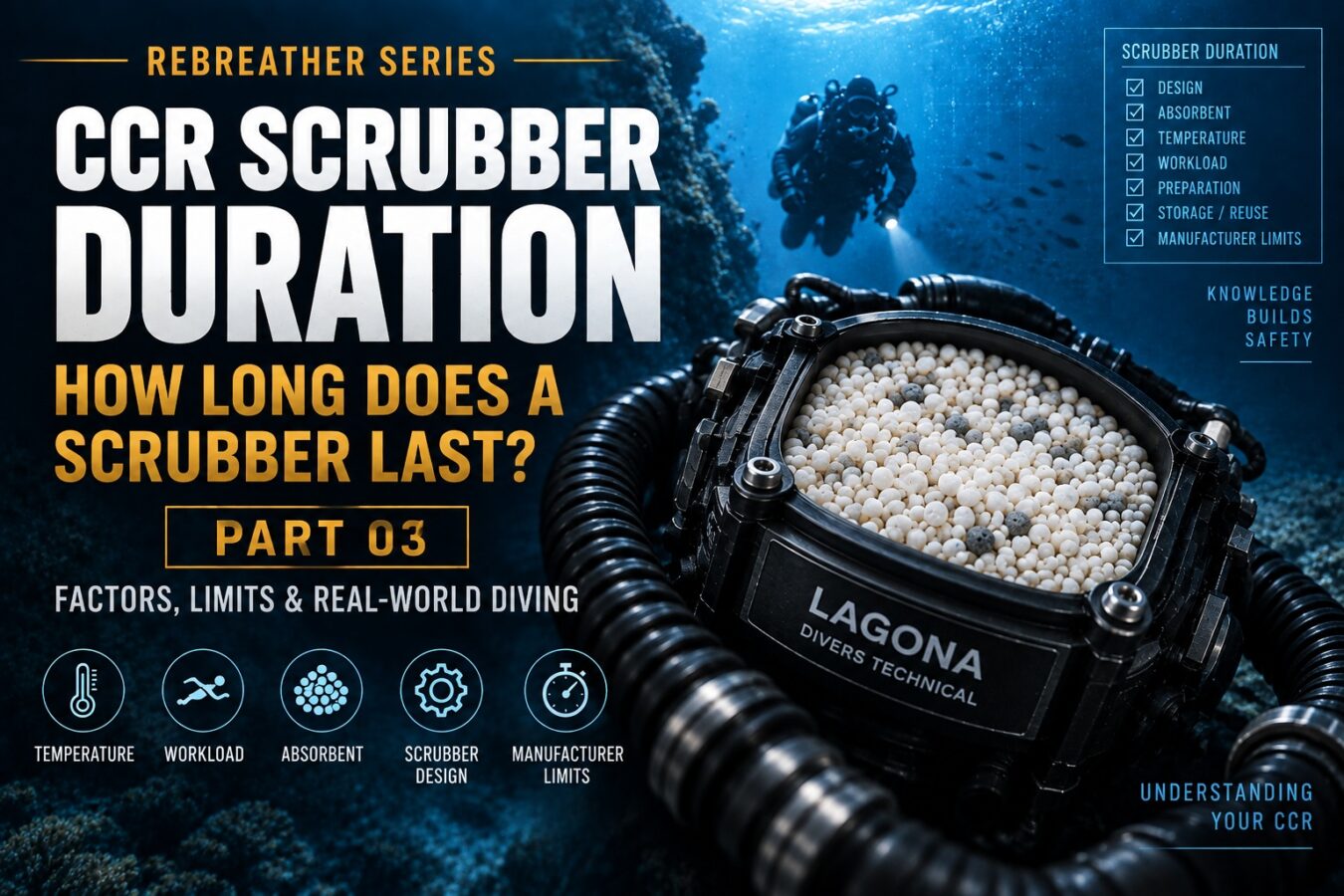
CCR Scrubber Duration: How Long Does a Scrubber Last?
How long does a CCR scrubber last? It sounds like a simple question, but the useful answer is not just a number of hours.
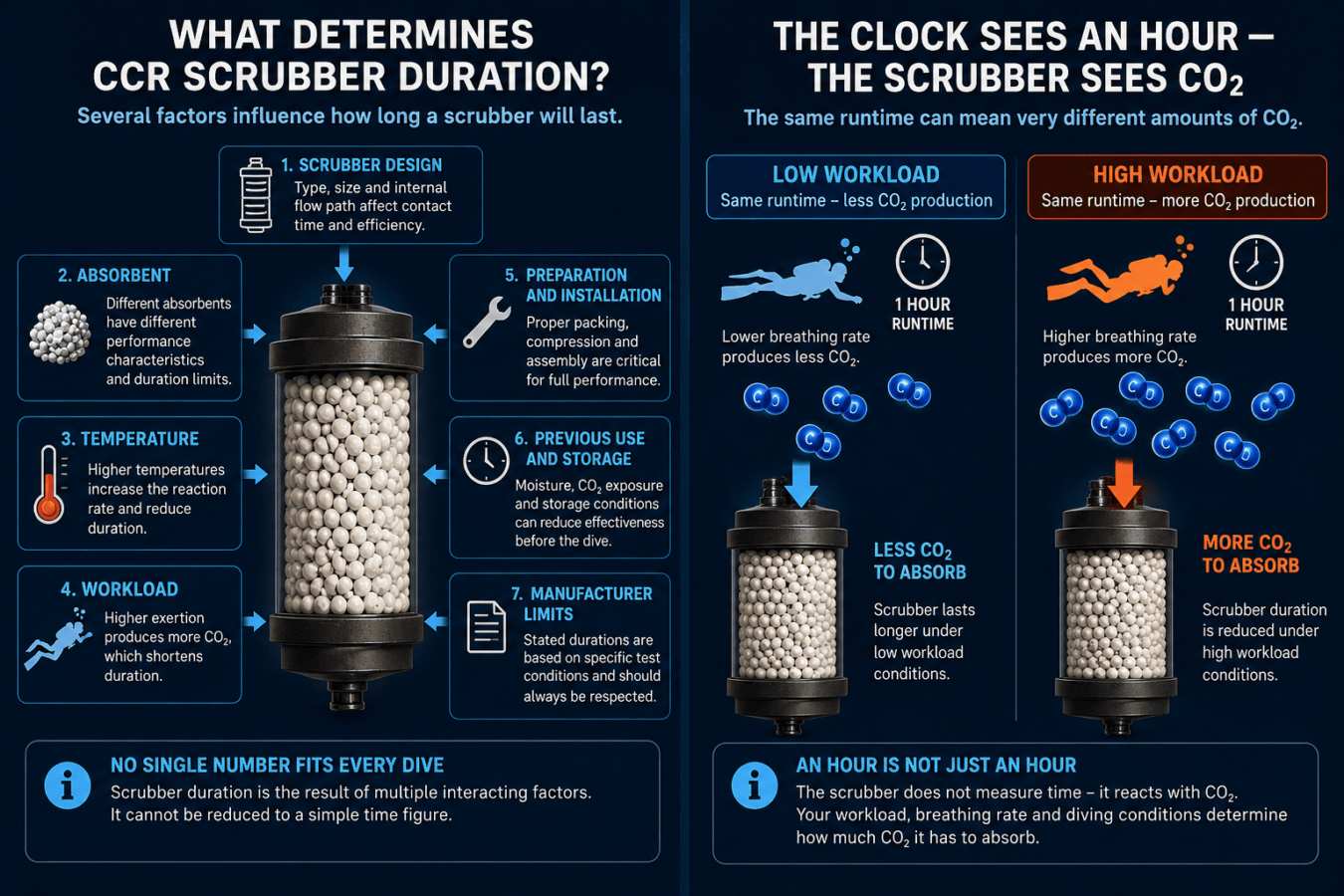
There is no universal CCR scrubber duration that applies to every rebreather. Usable scrubber time depends on the specific CCR and scrubber design, the approved absorbent, manufacturer testing and operating conditions such as temperature and diver workload.
The relevant duration and any rules concerning storage or reuse therefore need to come from the documentation and training for that particular CCR. A runtime taken from another rebreather, another scrubber design or another set of operating conditions cannot simply be transferred to your own unit.
A better way to approach the subject is to ask what determines the scrubber duration for a specific CCR and under which conditions that duration is valid.
That distinction matters because the scrubber is part of the rebreather’s life-support system. Managing it properly requires more than starting a timer when the dive begins.
CCR Scrubber Duration at a Glance
| Factor | Why it matters |
|---|---|
| CCR and scrubber design | Different systems have different scrubber geometry, gas-flow characteristics and tested operating limits. |
| Absorbent specification | The absorbent approved for the unit forms part of the tested scrubber system. |
| Temperature | Temperature influences the chemical process responsible for removing CO₂. |
| Workload | Higher metabolic workload generally produces more CO₂ for the scrubber to remove. |
| Preparation and installation | Breathing gas must travel through the scrubber as intended for effective use of the absorbent bed. |
| Previous use and storage | Reuse, storage and elapsed-time procedures differ between CCR systems. |
| Manufacturer limits | Published scrubber duration is associated with defined testing, equipment and operating conditions. |
The important point is that CCR scrubber duration is not determined by elapsed time alone. It is the performance of a specific scrubber system under a defined set of conditions.
What Does CCR Scrubber Duration Actually Mean?
A scrubber is a chemical system, and understanding how Sofnolime removes CO₂ in a rebreather helps explain why scrubber endurance cannot be treated like a simple countdown.
Manufacturers establish endurance limits under defined procedures and conditions. Those limits apply to the scrubber system that was tested and to the conditions under which the testing and validation were performed.
A duration figure associated with one CCR should therefore not automatically be transferred to another.
The relevant question is not:
“How many hours does Sofnolime last?”
It is:
“What scrubber duration has been established for this CCR, with this scrubber design and specified absorbent, under the applicable conditions and procedures?”
That distinction matters.
Why Is There No Universal CCR Scrubber Duration?
Rebreathers differ in more than their electronics, counterlung position or overall layout. Their scrubber systems can also differ significantly.
Different units may use different scrubber geometries, gas-flow arrangements, absorbent quantities, absorbent specifications and installation procedures. Manufacturer testing may also be performed under different defined conditions.
Because of those differences, a scrubber-duration figure from one unit is not automatically meaningful for another.
Even when two CCRs use the same brand or grade of absorbent, that does not make their scrubber systems equivalent. The absorbent works as part of the complete scrubber design, so geometry, gas flow, packing and the rest of the breathing system all matter.
For the diver, the appropriate reference remains the documentation and training for the specific CCR being used.
What Factors Affect CCR Scrubber Duration?
Several factors determine the conditions under which a scrubber has to remove carbon dioxide effectively. Some relate to the rebreather itself, while others relate to the environment or the diver using it.
Understanding those factors does not provide a formula for calculating your own operating limit. It explains why the tested limit is specific to the system and why apparently similar dives do not necessarily place identical demands on the scrubber.
Scrubber Design and Gas Flow
The shape and internal geometry of a scrubber affect how breathing gas moves through the absorbent bed and how effectively the available material can be used.
Gas needs to travel through the absorbent in the way intended by the scrubber design. If the geometry, assembly or gas path changes, the conditions under which the absorbent operates also change.
Different scrubber designs can therefore have different performance characteristics even when their absorbent looks similar from the diver’s perspective.
This is why the scrubber should be treated as a complete system rather than as a container whose performance is determined only by the quantity of Sofnolime inside it.
Absorbent Specification
The absorbent itself also matters.
CCR manufacturers specify or approve particular absorbents for their systems because characteristics such as grade, granule geometry and packing behaviour form part of the way the scrubber has been designed and tested.
For that reason, absorbent should not be treated as an interchangeable consumable chosen independently of the manufacturer’s procedures.
The relevant question is not simply whether a material can absorb CO₂. It is whether that absorbent is the one specified or approved for use in that particular scrubber system.
Temperature
Temperature influences the chemical process responsible for removing carbon dioxide. This is one reason scrubber-duration information only makes sense when the conditions associated with the figure are understood.
A published duration should therefore not be interpreted as a guarantee that the scrubber will provide identical performance under every possible combination of water temperature, workload and dive profile.
For the diver, the important lesson is not to invent a personal temperature correction formula. It is to understand why temperature forms part of scrubber testing and why practical operating limits need to come from the manufacturer guidance and training for the specific unit.
Understanding the influence of temperature should increase respect for the conditions attached to a scrubber limit rather than encourage the diver to reinterpret that limit independently.
Preparation and Installation
Active absorbent is only useful if breathing gas passes through the scrubber system as intended.
Correct preparation, filling, assembly and installation therefore form part of scrubber management. A granular scrubber that has been packed incorrectly or assembled in a way that affects the intended gas path is not operating under the same conditions as a correctly prepared system.
Procedures also differ between scrubber designs. A method learned on one rebreather should not automatically be transferred to another simply because both units use granular absorbent.
This is another reason scrubber management is more than a matter of recording hours. The physical preparation of the system affects the conditions under which those hours are accumulated.
Previous Use and Storage
A scrubber that has already been used introduces another layer of management.
The diver may need to know how much previous use has been recorded, how the scrubber should be stored, whether reuse is permitted and whether additional elapsed-time restrictions apply.
Those questions do not have one universal answer for all rebreathers. Storage and reuse procedures are unit-specific and should be followed according to the manufacturer’s documentation and the training received for that CCR.
Accurate runtime tracking remains important, but runtime is only one part of the information required to manage a partially used scrubber correctly.
Axial vs Radial Scrubber Design
CCR scrubbers can use different arrangements for moving gas through the absorbent. Two commonly discussed configurations are axial and radial flow.
In an axial scrubber, breathing gas generally moves through the absorbent along the length of the bed, entering at one end and leaving toward the other. In a radial scrubber, gas moves across the absorbent radially, typically between inner and outer surfaces of the scrubber..
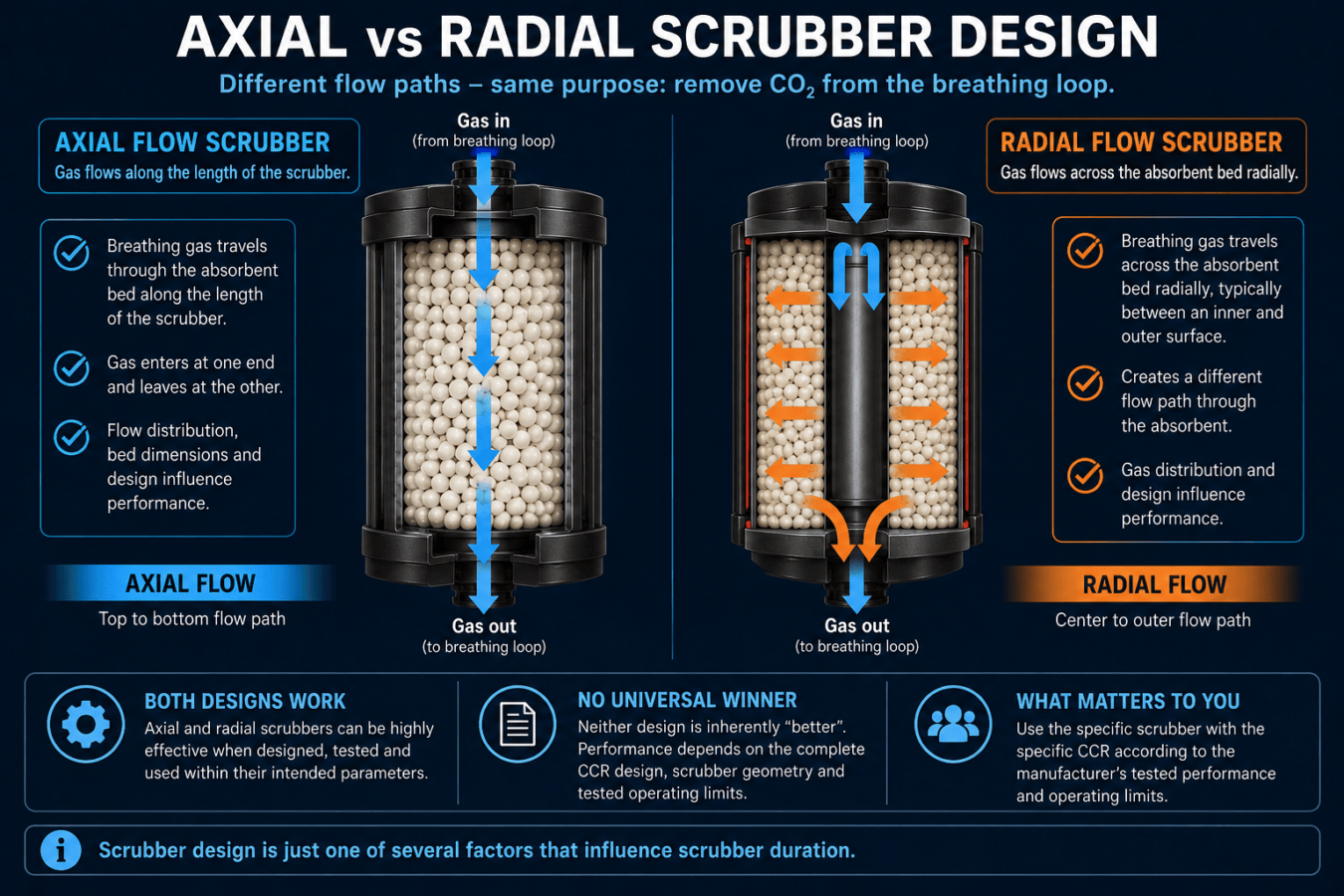
These arrangements create different gas-flow paths and different geometric relationships between the breathing gas and the absorbent.
Neither design should be treated as universally better simply because of its flow direction. Bed dimensions, gas distribution, absorbent characteristics and the overall CCR design all influence performance.
For the diver, the practical reference remains the tested performance and operating limits of the scrubber installed in the specific CCR.
How Does Workload Affect CCR Scrubber Duration?
Workload deserves particular attention because the scrubber is not receiving carbon dioxide at a fixed rate independent of the diver.
The CO₂ the scrubber has to remove is produced by your metabolism.
As metabolic workload increases, carbon dioxide production generally increases as well. A diver moving efficiently in calm conditions and the same diver working hard against current may spend the same amount of time on the breathing loop, but they do not necessarily place the same metabolic demand on the scrubber.
This is why elapsed time alone gives an incomplete picture.
One hour is still one hour on the clock, but the scrubber is dealing with the quantity of carbon dioxide produced during that hour. The chemical demand placed on the absorbent can therefore differ even when the runtime is identical.
That does not mean the diver should calculate a personal scrubber extension based on perceived workload. It means that workload helps explain why scrubber performance is condition-dependent and why established operating limits matter.
Can You Simply Add Up CCR Dive Times?
Logging scrubber use is an important part of CCR management, but adding up dive times does not automatically describe every condition relevant to a partially used scrubber.
Storage conditions, elapsed time between dives, reuse restrictions and any approved monitoring technology are specific to the particular system. The diver therefore needs to understand not only how much time has been accumulated, but also which procedures apply between uses.
A scrubber log or timer is useful because it helps the diver remain within established procedures. It should not become the basis for creating a personal endurance model that replaces manufacturer guidance.
There is an important difference between accurately tracking use and independently deciding how far a scrubber can be pushed.
Manufacturer CCR Scrubber Duration vs Real-World Diving
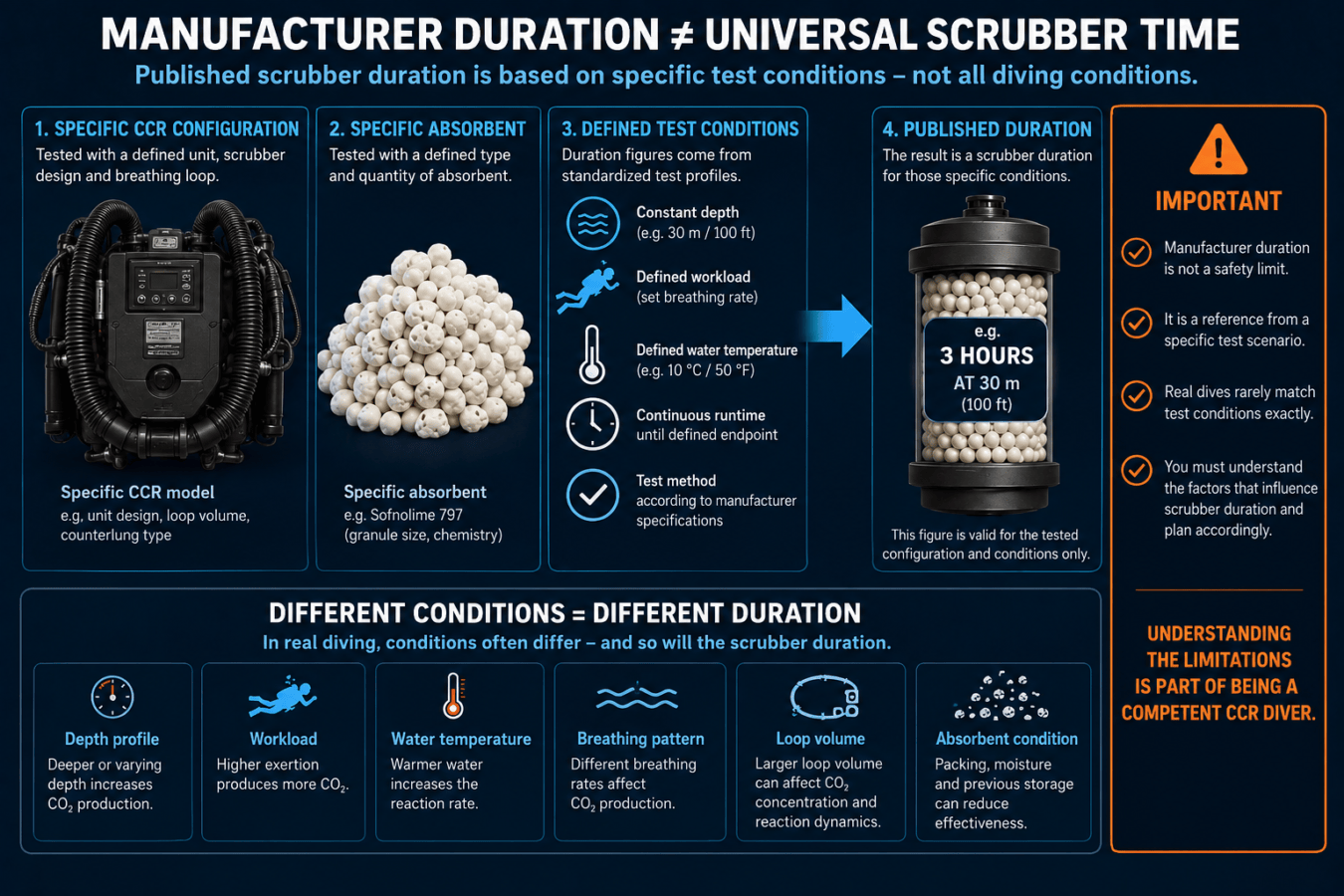
A manufacturer’s scrubber-duration figure is associated with defined test parameters and operating conditions.
Real-world diving will not reproduce every test condition exactly. Water temperature changes, diver workload changes, and actual dive profiles vary considerably.
The fact that real-world conditions differ from laboratory or certification testing does not make the manufacturer’s limit irrelevant. It makes understanding the context of that limit more important.
One mistake in technical thinking is to understand why a limitation exists and then use that knowledge as justification for operating beyond it.
Those are not the same thing.
Understanding condition-dependent scrubber performance gives the diver better knowledge of the life-support system. Extending established limits is a different decision entirely and effectively turns the dive into an experiment with that system.
The useful goal is to understand the reason behind the limit while continuing to operate within the procedures established for the equipment and training.
Can a Scrubber Monitor Tell You How Much Time Is Left?
Some CCR systems use temperature information because the chemical removal of CO₂ releases heat. Depending on the design, monitoring technology can therefore provide information related to activity within the scrubber.
That does not automatically turn the monitor into a universal fuel gauge showing exactly how many minutes of usable absorbent remain.
The capabilities and limitations of scrubber monitoring depend on the particular technology and rebreather. A diver needs to understand what the system actually measures, how the manufacturer intends the information to be interpreted and how that information fits into the established scrubber-management procedures for the unit.
Monitoring technology can provide useful additional information, but it does not remove the need to understand the scrubber or make the established limits of the system irrelevant.
Why a Prebreathe Is Not a CO₂ Guarantee
A prebreathe forms part of the operating procedures for many rebreathers and can confirm several aspects of CCR function before the dive.
It should not, however, be interpreted as proof that the scrubber will remove carbon dioxide adequately throughout the entire dive.
A normal-feeling prebreathe does not replace correct scrubber preparation, installation, tracking, storage or adherence to the operating limits established for the unit. It also does not create additional scrubber capacity.
The useful approach is to perform the prebreathe according to the procedures for the CCR while understanding both what that check can tell you and what it cannot.
What Happens When a CCR Scrubber No Longer Removes Enough CO₂?
Scrubber duration ultimately matters because the carbon dioxide produced by the diver has to be removed before the breathing gas returns through the loop.
As absorbent capacity is consumed, the scrubber eventually becomes less capable of removing the incoming CO₂ load. When carbon dioxide passes through the scrubber without being removed adequately, this is known as scrubber breakthrough.
Breakthrough is more complicated than a timer simply reaching zero. Absorbent exhaustion matters, but so do gas flow, the condition of the scrubber bed and the way the active reaction region progresses through the absorbent.
That is why scrubber duration and scrubber breakthrough are related concepts without being exactly the same subject.
CCR Scrubber Management Is More Than Watching the Clock
A knowledgeable CCR diver should understand the context behind the runtime figure rather than simply memorizing the number.
That means knowing which absorbent is specified for the unit, what conditions are associated with the stated scrubber duration, how diver workload changes the amount of CO₂ entering the scrubber and which procedures apply to storage and reuse.
It also means understanding what any scrubber-monitoring technology on the unit actually measures and where its limitations lie.
All of those factors lead back to one central idea: the objective is not to extract the maximum possible number of minutes from the absorbent.
The objective is to operate the life-support system consistently within the limits established for that specific CCR.
That distinction is particularly important for divers entering CCR or developing their rebreather knowledge further. Good training should not merely provide a runtime number to memorize; it should explain what that number represents, why operating conditions matter and why the procedures surrounding the scrubber exist.
Frequently Asked Questions About CCR Scrubber Duration
How long does a CCR scrubber last?
There is no universal CCR scrubber duration. The applicable duration depends on the specific rebreather, scrubber design, approved absorbent, manufacturer testing and operating conditions. The relevant limits should come from the documentation and training for the CCR being used.
Does cold water affect CCR scrubber duration?
Temperature affects the chemical process responsible for CO₂ removal and is therefore relevant to scrubber performance and testing. Practical operating limits should come from the manufacturer guidance for the specific CCR rather than from a generic cold-water adjustment.
Does workload affect CCR scrubber duration?
Yes. Increased metabolic workload generally increases carbon dioxide production, which increases the amount of CO₂ the scrubber needs to remove. This is one reason elapsed dive time alone does not describe every condition affecting scrubber use.
Can I reuse a partially used CCR scrubber?
Potentially, depending on the procedures established for the specific rebreather. Reuse, storage and elapsed-time restrictions vary between CCR systems and should be followed according to the relevant manufacturer guidance and training.
Can a CCR scrubber monitor tell me exactly how much time is left?
Not necessarily. Monitoring systems differ in what they measure and how that information is intended to be used. Their readings should be interpreted according to the specific rebreather and manufacturer procedures rather than treated as a universal indication of remaining scrubber time.
What is CCR scrubber breakthrough?
Scrubber breakthrough occurs when carbon dioxide passes through the absorbent bed without being removed adequately. It is related to scrubber duration, but it is not simply the moment when a timer reaches zero.
Can a successful prebreathe prove the scrubber will last for the dive?
No. A prebreathe can form part of the pre-dive checks for a CCR, but it does not prove that sufficient scrubber capacity will remain throughout the planned dive or replace correct scrubber tracking and operating limits.
Understand Your CCR, Not Just Its Runtime
A CCR scrubber-duration figure is important, but knowing the number is not the same as understanding the system.
A CCR diver should understand where the scrubber limit comes from, which conditions are associated with it, how equipment design, temperature and workload influence the context in which the scrubber operates, and why manufacturer- and unit-specific procedures matter.
That knowledge should not be used to push closer to the edge of the scrubber’s capability. It should help the diver operate the rebreather more consistently and intelligently within its established limits.
At Lagona Divers Technical, we approach CCR training with the same principle used throughout this series. Training should not simply teach a sequence of procedures or provide numbers to memorize. It should help divers understand their equipment, recognize its limitations, develop the necessary skills and understand why those procedures and limits exist.
When you understand what the scrubber-duration figure actually represents, the number becomes more useful rather than less important. You are no longer simply watching a clock; you understand the life-support system that the clock is helping you manage.
Explore CCR training with Lagona Divers Technical in the Red Sea or contact us to discuss the right rebreather training pathway for your experience and diving goals.